If you are reading this because it is happening right now, skip to what to do in the next hour. Everything else can wait.
Sextortion is a crime in which someone obtains an intimate image of a person — or claims to have one — and then threatens to share it unless the victim pays money, sends more images, or does something else they demand. When the target is a child, it is a serious federal crime, and the child is never the one at fault.
Most parents have never heard the word. Neither have most children — and that is precisely what makes it work. This guide explains what sextortion is, how it actually unfolds, the one sentence that protects a child better than any app, and exactly what to do if it has already started.
What Sextortion Is — and What Financial Sextortion Is
The word covers two different crimes with different motives.
Traditional sextortion is sexually motivated. An offender uses an image to coerce a child into producing more images or into sexual contact. Historically, about half of these offenders were known to the victim from their offline life.
Financial sextortion is the version that has exploded, and it is not about sex at all — it is about money. An offender poses as a peer, obtains one image, and immediately demands payment. Thorn’s analysis of NCMEC report data found these offenders are concentrated internationally, with 47% of reports showing ties to Nigeria and Côte d’Ivoire. These are not lonely predators in the next town. They are organised crews running a script, at volume, for profit.
That distinction matters for parents, because the second type moves in hours, targets a demographic most parents don’t worry about, and ends in a demand for money rather than a request to meet.
How Big the Problem Actually Is
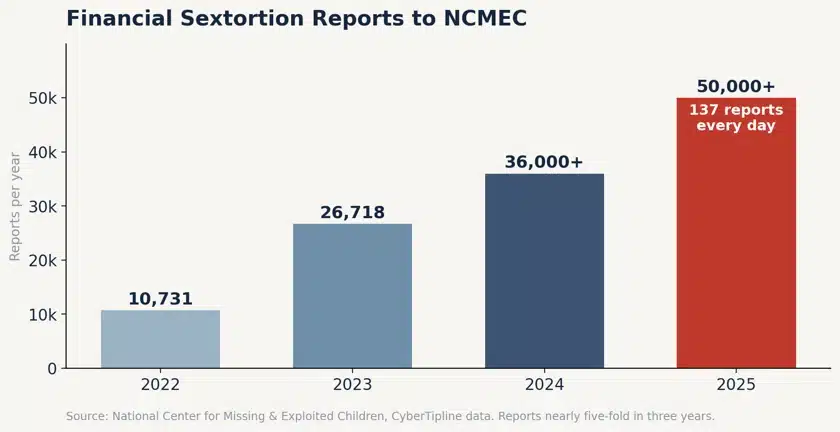
Figure 1 — Financial sextortion reports to NCMEC, 2022–2025. Source: National Center for Missing & Exploited Children.
In 2025, NCMEC received more than 50,000 reports of financially motivated sextortion — an average of 137 every day, and a 37% increase in daily reports over the year before. In 2022 the figure was 10,731. It has grown roughly five-fold in three years.
The human cost is not abstract. NCMEC is aware of at least three dozen teenage boys in the United States who have taken their own lives after being victimised by this crime since 2021.
Who It Targets — and Why It’s Probably Not Who You Expect
Ask a parent to picture a child at risk from an online predator and most describe a young girl. The data says otherwise. In Thorn’s analysis of NCMEC reports, 90% of financial sextortion victims were male, aged 14 to 17.
There are reasons this demographic is targeted so effectively. Teenage boys are more likely to be approached by an account posing as a girl their age and to reciprocate quickly. They are less likely to have been warned — most safety messaging about online sexual risk is aimed at girls. And the shame is weaponised precisely: the threat is not only “I’ll post this,” it’s “I’ll send it to your mother, your team, your school.”
If you have a fourteen-year-old son and you have never discussed this with him, that is the single most likely gap in your family’s online safety right now.
How It Actually Happens
The script is consistent, and knowing it is most of the protection.
- The approach. A follow or DM from an attractive peer-aged account — usually a girl, on Instagram, Snapchat or a game. The account looks real because it was built from a real person’s stolen photos.
- The move to private. The conversation shifts fast to Snapchat, WhatsApp or another encrypted app. NCMEC notes offenders are increasingly moving to private and encrypted platforms, which makes detection harder and means some of these conversations are invisible to any monitoring anywhere.
- The trade. She sends an image first — often a stolen one — then asks for one back. This reciprocity is the hook. It feels mutual, and it feels like the child’s own choice.
- The turn. The moment an image arrives, the persona drops. Within minutes come screenshots of the child’s follower list, their school, their family. Then the demand: gift cards, a payment app, cryptocurrency.
- The escalation. Paying doesn’t end it. It confirms the victim will pay. NCMEC’s own guidance is unambiguous: cooperating or paying rarely stops blackmail.
Total elapsed time is often under an hour. A child can go from a normal evening to believing their life is over before dinner is finished.
If It Is Happening Right Now
In this order.
- Tell your child they are not in trouble — say it first, say it out loud. Their fear of your reaction is the thing the blackmailer is counting on.
- Stop all contact. Do not delete the account. Block the offender, but preserve the profile, usernames, and messages — that’s the evidence.
- Do not pay. Not the first demand, not a partial payment. Paying marks the child as a paying target and the demands continue.
- Screenshot everything — the profile, the handle, the messages, the payment details demanded. Record where the images are, but do not download or forward an intimate image of a minor; that creates its own legal problem.
- Report to NCMEC’s CyberTipline at report.cybertip.org, and to the FBI at ic3.gov or your local police. In the UK, contact the CEOP Safety Centre.
- Use Take It Down. NCMEC’s free service at takeitdown.ncmec.org helps remove intimate images of minors from participating platforms — without you having to send the image anywhere. Since 19 May 2026, the TAKE IT DOWN Act has also obliged covered platforms to remove reported non-consensual intimate imagery within 48 hours of a valid request. Cite the Act by name when you file.
- Watch your child, closely, for days. This is the part that gets missed. The danger does not end when the account is blocked. If there is any sign of self-harm or suicidal thinking, call or text 988 (Suicide & Crisis Lifeline, US, 24/7). Stay with them.
Say this to your child, in these words: this is a crime committed against you by an adult criminal. It has happened to tens of thousands of kids this year. It is survivable, and we are going to handle it together.
The Number That Should Change How You Think About This
Here is the finding that undercuts the usual story about teenagers and silence. When NCMEC looked at public sextortion reports where the relationship to the victim was known, 94% came from the child victim or their parent — and most were submitted by the children themselves.
Children do report this. They are not, as a rule, hiding it out of stubbornness. What stops them is not knowing what is happening until they are already deep in it — and Thorn’s research found that roughly two-thirds of young people have never heard the word “sextortion”.
That reframes the job. The gap is vocabulary, not willingness. A child who has heard the word, once, in a calm moment, has a name for what is happening on the worst night of their life — and a name is what makes it reportable instead of unspeakable.
Prevention: Two Conversations and One Sentence
Name the crime before it happens
Not a lecture. Ninety seconds at dinner: “There’s a scam going around where someone pretends to be a girl your age, gets a photo, then demands money. It’s targeting boys. If it ever happens — to you or a friend — you come to me and you don’t pay. Nobody’s in trouble.”
Say it before they have a phone. Say it again at fourteen. That is the whole intervention.
Say the amnesty clause, and mean it
If you bring me a problem — even one you caused — my first job is to help, not punish. In sextortion cases this single household rule is the difference between a child who tells you on night one and a child who pays a stranger in silence for a month. It costs nothing, and on this evidence it outperforms every product on the market.
Reduce the surface
- Private accounts by default; no accepting follows from people they haven’t met.
- Talk about the reciprocity trick specifically — “she sent one first” is the hook, not proof of good faith.
- Make sure they know an image of a peer-aged girl proves nothing about who is typing.
What About Sexting?
Sexting and sextortion get conflated, and it’s worth separating them. Sexting between teenagers is a distinct issue with its own risks — images shared consensually get forwarded, relationships end badly, and in some jurisdictions minors have faced serious legal consequences for images of themselves.
But framing sextortion as “a sexting problem” leads parents to the wrong response, which is usually shame. In financial sextortion, the child is the target of an organised criminal operation using a script refined on thousands of other children. Treating that as a lapse in judgement is both wrong and actively dangerous — shame is the mechanism the crime runs on.
Where Monitoring Software Fits
Honestly: less than you’d hope, and less than this industry usually claims. No app can prevent sextortion. The approach arrives through a normal social platform, the conversation moves to an encrypted app within minutes, and the child sends the image themselves believing it’s their own choice. There is no toggle in that chain.
What a parental monitoring app can do is narrow the gap between “it started” and “a parent knows.” TheOneSpy’s unknown-contact and keyword alerts can surface a new account that appeared from nowhere and dominated your child’s attention, or a sudden change in activity at 1am — across Android, iPhone/iPad, Windows and Mac. Given that this crime can run its whole course in an hour, and that shame is what keeps a child quiet, earlier is genuinely better.
But it works only openly — installed with your child’s knowledge, explained honestly, scaled back as they grow. And it ranks below the two things above it: naming the crime, and the amnesty clause. Those are free, and they are what actually works.
Frequently Asked Questions
What is sextortion?
Sextortion is a crime where someone threatens to share an intimate image of a person unless they pay money, send more images, or comply with other demands. When the victim is a child it is a serious federal crime, and the child is never at fault. The fastest-growing form is financial sextortion, where the goal is money rather than sexual contact — NCMEC received more than 50,000 reports of it in 2025, an average of 137 a day.
Who does sextortion target?
Overwhelmingly teenage boys. In Thorn’s analysis of NCMEC report data, 90% of financial sextortion victims were male, aged 14 to 17. Offenders are largely organised international crews — 47% of reports showed ties to Nigeria and Côte d’Ivoire — running a repeatable script for profit, not local predators.
What should I do if my child is being sextorted?
Tell them they’re not in trouble. Stop all contact but don’t delete the account. Do not pay — NCMEC is clear that cooperating or paying rarely stops blackmail. Screenshot the evidence, report to report.cybertip.org and the FBI at ic3.gov, and use NCMEC’s free Take It Down service at takeitdown.ncmec.org. Then stay close to your child for several days; if there are any signs of self-harm, call or text 988.
Should I pay the blackmailer to make it stop?
No. Paying confirms you’ll pay and the demands continue. NCMEC’s guidance is explicit: get help before deciding whether to pay or comply, because cooperating rarely stops the blackmail.
How do I talk to my child about sextortion?
Briefly and early. Name the scam — someone posing as a peer, getting an image, then demanding money — and say two things: you come to me, and you don’t pay. Roughly two-thirds of young people have never heard the word “sextortion,” which is exactly why it works. A child who has a name for it can report it.
Sources
- National Center for Missing & Exploited Children — CyberTipline data (2025): 50,000+ financial sextortion reports, 137/day, 37% year-on-year increase; at least three dozen teen suicides since 2021; 94% of public reports from victim or parent
- Thorn — Trends in Financial Sextortion: an investigation of sextortion reports in NCMEC CyberTipline data (90% male victims aged 14–17; 47% offender ties to Nigeria and Côte d’Ivoire)
- NCMEC — Sextortion resource centre
- NCMEC Take It Down — free image removal service for minors
- TAKE IT DOWN Act (Pub. L. No. 119-12), signed 19 May 2025; platform notice-and-removal obligations effective 19 May 2026
- FBI Internet Crime Complaint Center (IC3) · CEOP Safety Centre (UK)
- 988 Suicide & Crisis Lifeline — call or text 988 (US, 24/7)