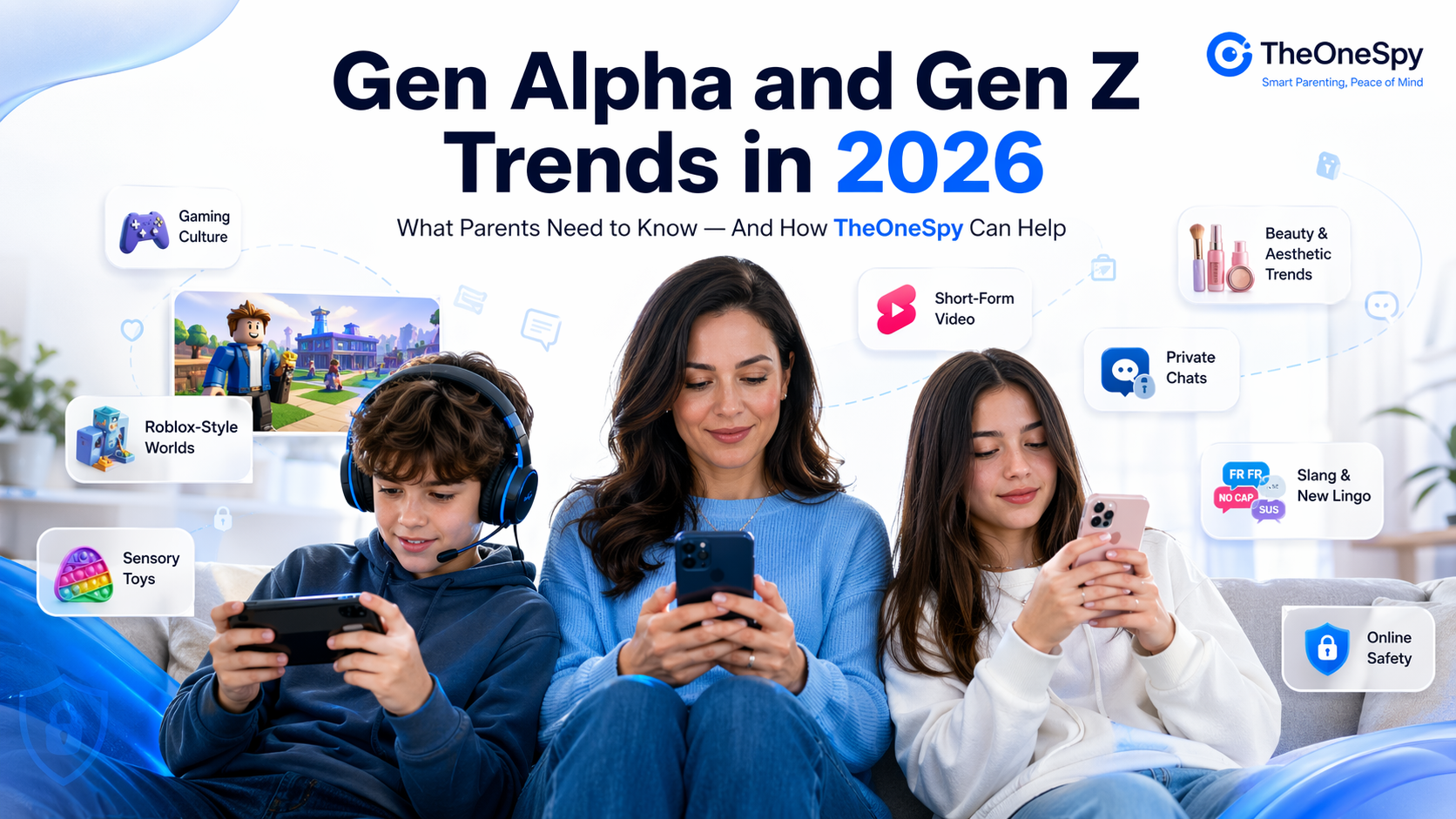
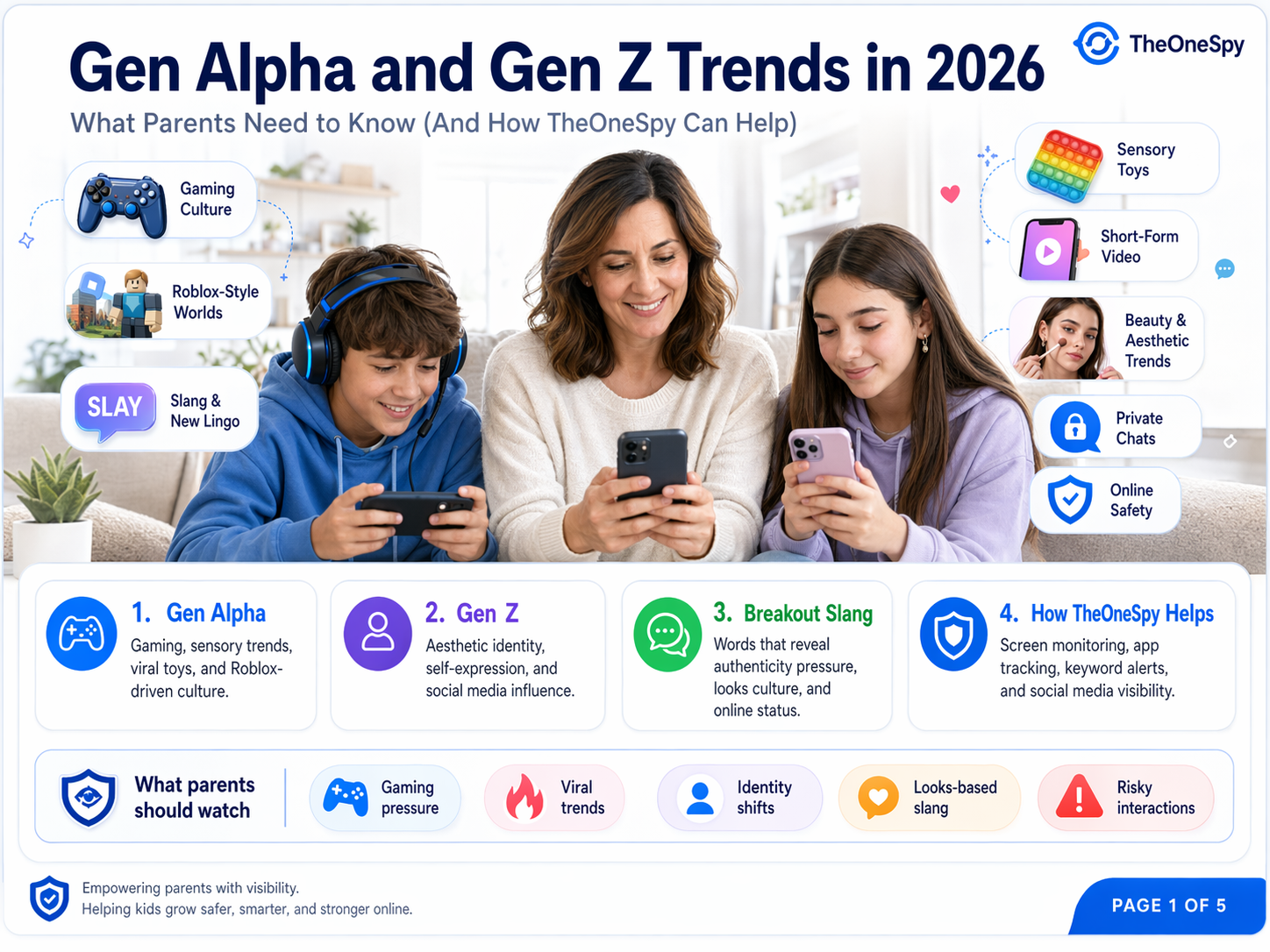
 If you have ever overheard your child say something that made absolutely no sense to you, you are not alone. In 2026, the cultural worlds of Gen Alpha and Gen Z have evolved into something so fast-moving and layered that even the most plugged-in parents struggle to keep up. From Roblox-inspired slang bleeding into real-life conversations to viral sensory toys that sell out within weeks, the way younger generations communicate, play, and express themselves is shifting faster than ever before.
This is not just a pop culture curiosity. For parents, educators, and anyone responsible for the well-being of children and teenagers, understanding these trends is a matter of genuine importance. What your child is watching, playing, and saying online reflects a social world that largely plays out on screens — and if you are not paying attention, you could easily miss early signs of influence, pressure, or risk. That is exactly where tools like TheOneSpy become essential.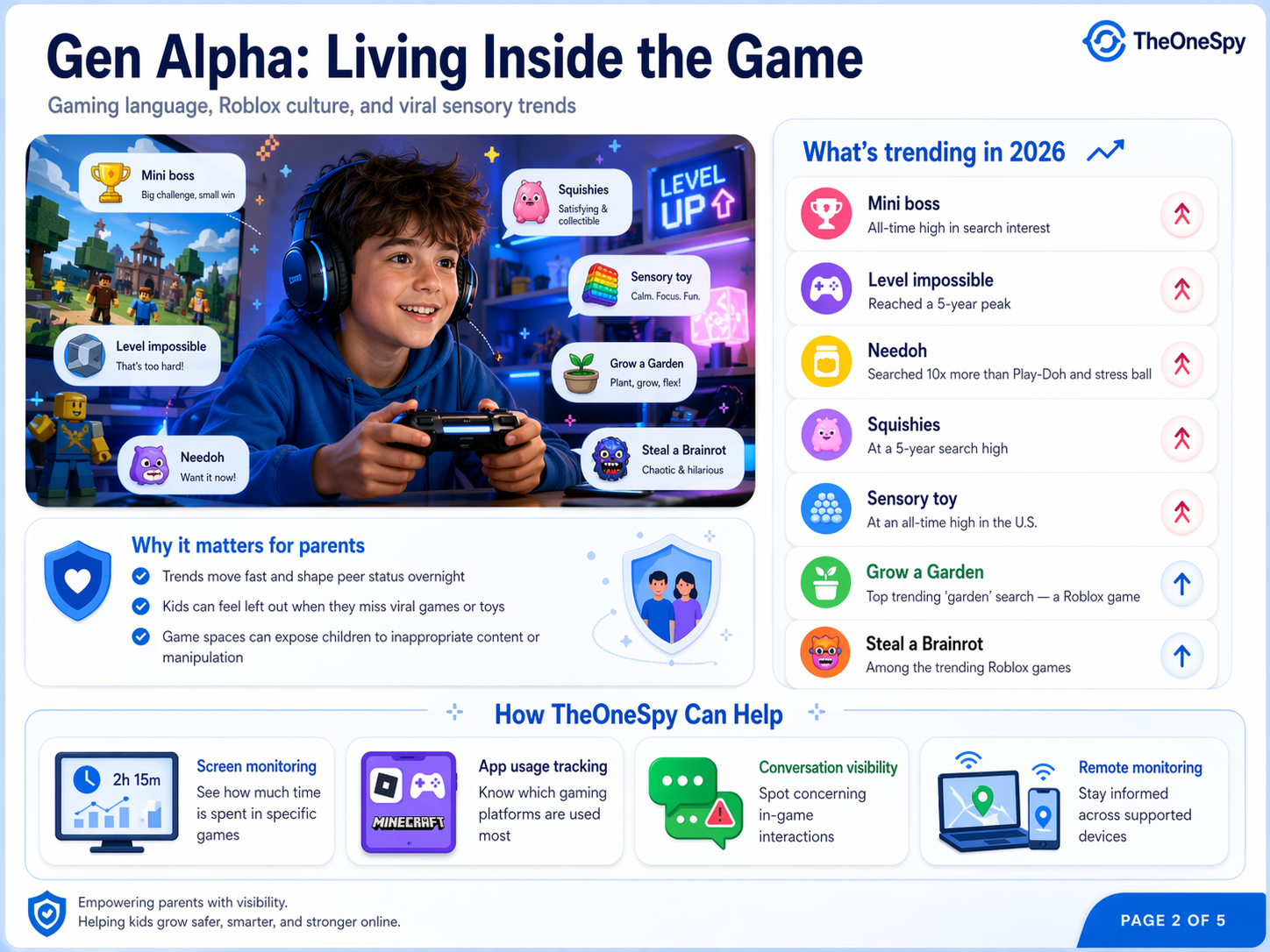
Gen Alpha: Living Inside the Game
Walk into any elementary school today, and you will hear words like “NPC,” “mini boss,” and “level impossible” dropped casually into lunch table conversations. These are not just gaming terms anymore — they are the everyday language of Gen Alpha, a generation that has grown up with Roblox as a social platform, not just a game.
Search data from 2026 confirms just how deep this goes. The term ”mini boss” has hit an all-time high in search interest, and ”level impossible” reached a five-year peak earlier this year. These phrases have migrated out of game lobbies and into schoolyard vocabulary, family dinners, and even classroom talk.
One of the most striking examples of Gen Alpha’s fast-moving consumer culture is the recent explosion of sensory toys. ”Needoh” — a squishy, stress-relief ball — broke out in search interest over the past month, being searched over ten times more than both “Play-Doh” and “stress ball.” Squishies are at a five-year search high, and the broader term ”sensory toy” has hit an all-time high in the United States. These are not random product spikes. They reflect a generation that is tactile, stimulation-seeking, and highly influenced by peer-driven viral content.
And then there is Roblox. Grow a Garden is currently the top-trending search related to “garden” across the entire past year — not a gardening how-to guide, not a landscaping company, but a Roblox game. It also sits at the top of trending Roblox games, followed by Steal a Brainrot, a title that tells you something about the humor and sensibility Gen Alpha gravitates toward.
What This Means for Parents
The concern here is not that children enjoy gaming or sensory toys. These are largely normal, healthy interests. The deeper issue is the speed and intensity at which these trends move. A product can go from unknown to sold out to forgotten within weeks. A game can become the social center of a child’s peer group overnight. Children who feel left out of these trends — who do not have the latest squishy toy or have not played the trending Roblox game — can face real social pressure.
There is also the question of what happens inside these games. Roblox is a platform with millions of user-created experiences, and not all of them are appropriate for young children. Predatory behavior, inappropriate content, and social manipulation can occur in game environments just as easily as on social media.
TheOneSpy helps parents stay informed without being intrusive. With its screen monitoring and app usage tracking features, parents can see how much time their child is spending in specific games, what conversations are happening within gaming platforms, and whether any concerning interactions are taking place. TheOneSpy’s remote monitoring capabilities work across Android and other devices, giving parents a quiet but clear window into their child’s digital life.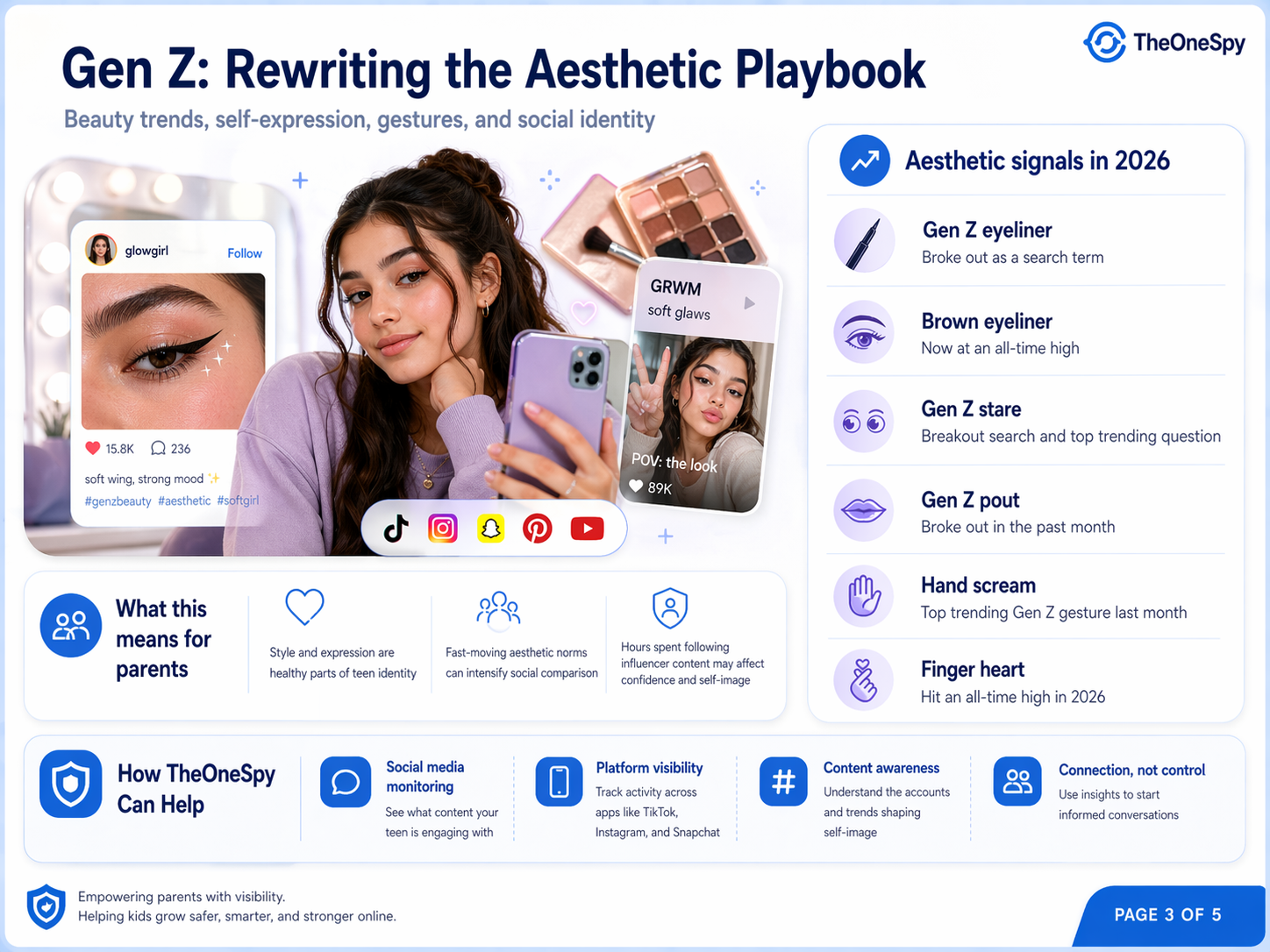
Gen Z: Rewriting the Aesthetic Playbook
If Gen Alpha is defined by gaming culture, Gen Z in 2026 is defined by its deliberate separation from the trends that defined older millennials. This generation is not interested in being lumped in with late-2010s aesthetics. They are actively building something new — and the data shows it.
One of the clearest signals is the shift away from the classic cat eye eyeliner look that dominated millennial and early Gen Z makeup trends. In its place, ”Gen Z eyeliner” broke out as a search term in the past month, and the top-trending color paired with it is brown eyeliner, which is now being searched for more than at any previous point on record. This is a subtler, warmer, more natural aesthetic that deliberately distances itself from the sharp, high-contrast looks of the early 2010s.
But it goes beyond makeup. Gen Z is also developing its own physical expression language. The ”gen z stare”— a flat, slightly glazed expression associated with ironic detachment — broke out in search interest this past year, with “what is a gen z stare” becoming a top trending question. The ”Gen Z pout” also broke out as a search term in the past month. Meanwhile, new hand gestures are going mainstream: the ”hand scream” was the top trending Gen Z gesture last month, and the ”finger heart” hit an all-time high in 2026.
These are not just quirky social media moments. They are identity markers. Gen Z uses specific expressions, gestures, and aesthetics to signal membership, values, and distance from older cultural norms. For teenagers navigating social hierarchies, getting these signals right — or wrong — can carry real social weight.
What This Means for Parents
Teenagers have always used style and expression to build identity, and that is a healthy and important part of development. But the pressure to conform to rapidly shifting aesthetic standards, broadcast over platforms like TikTok and Instagram, can create anxiety and self-consciousness that is worth paying attention to.
Parents who notice sudden and dramatic changes in how their teen presents themselves online — or who see their child spending hours comparing themselves to influencer content — should take that seriously. The line between healthy identity exploration and unhealthy social comparison is not always obvious, and it often plays out on screens where parents are not watching.
TheOneSpy’s social media monitoring features allow parents to keep tabs on what their teenagers are viewing and engaging with across platforms. Whether it is Instagram, Snapchat, or TikTok, TheOneSpy can provide parents with insight into the type of content their teen is consuming, the accounts they follow, and the conversations they are having. This is not about control — it is about staying connected to a part of your teenager’s life that genuinely affects their mental health and self-image.
Breakout Slang: Hyper-Individualism, Authenticity, and Looks Culture
Perhaps the most culturally loaded section of 2026’s trend data is the breakout slang. These words and phrases reveal something important about the values and anxieties of younger generations — and some of it carries a sharp edge.
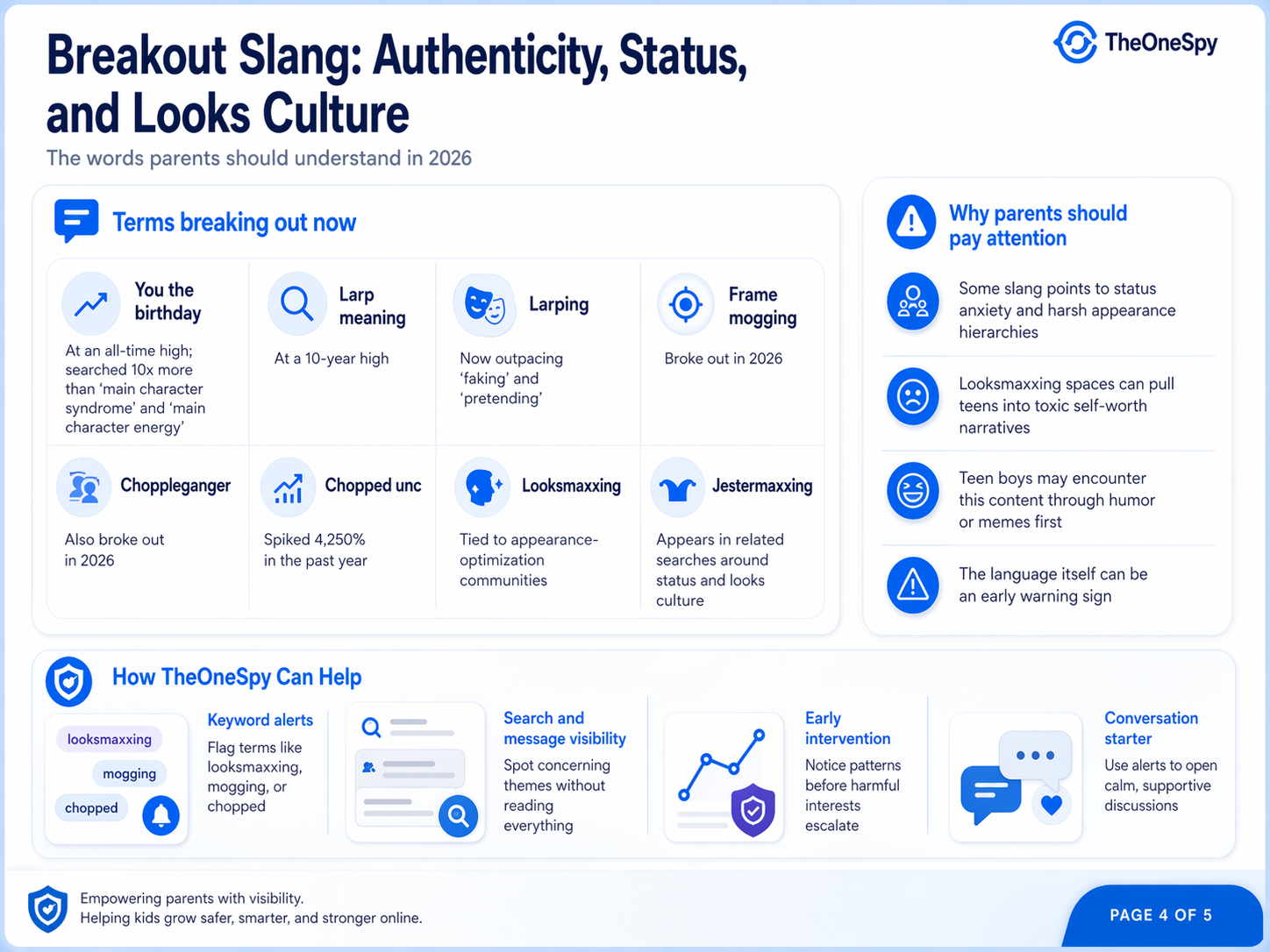
The phrase ”you the birthday” has hit an all-time high, signaling a peak in main-character culture — the idea that one person sees themselves as the center of their social universe. It was searched over ten times more than “main character syndrome” and “main character energy” in the past month alone.
At the same time, there is a powerful counter-trend: calling out inauthenticity. ”Larp meaning” is at a ten-year high, and ”larping” — originally a term for live-action role-playing — has surpassed search interest in words like “faking” and “pretending.” In current slang, calling someone a “larper” means accusing them of performing a life or identity they do not actually have. This is a generation deeply attuned to authenticity, or at least the performance of it.
Then there is the looks-based slang, which is where things get more complicated. ”Frame mogging” broke out in 2026 — referring to physically dominating or overshadowing others based on body size or build. ”Choppleganger” also broke out, a portmanteau combining “chopped” (meaning unattractive) with “doppelganger” — essentially a term for someone’s uglier lookalike. The term ”chopped unc” spiked an astonishing 4,250% in the past year. People searching “frame mogging” were also looking up “jestermaxxing” and “looksmaxxing” — terms tied to online communities that obsess over physical optimization and hierarchies based on appearance.
What This Means for Parents
This is where parents need to pay the closest attention. Looksmaxxing communities exist in corners of the internet that glorify extreme physical self-improvement and, at their worst, promote harmful body image ideals and misogynistic hierarchies. Young people — particularly teenage boys — can be drawn into these communities through seemingly harmless content, only to find themselves absorbing deeply toxic ideas about self-worth and dominance.
The language itself is a signal. If your teenager is casually using terms like “frame mogging,” “looksmaxxing,” or “chopped,” it is worth understanding what those words mean in context and where they encountered them.
TheOneSpy’s keyword alert feature is particularly valuable here. Parents can set specific keywords — including terms like “looksmaxxing,” “mogging,” or others from this glossary — and receive alerts when those words appear in their child’s messages, searches, or social activity. Rather than reading through every conversation, TheOneSpy flags the moments that actually warrant attention, helping parents intervene early and start a conversation before a concerning interest becomes a harmful pattern.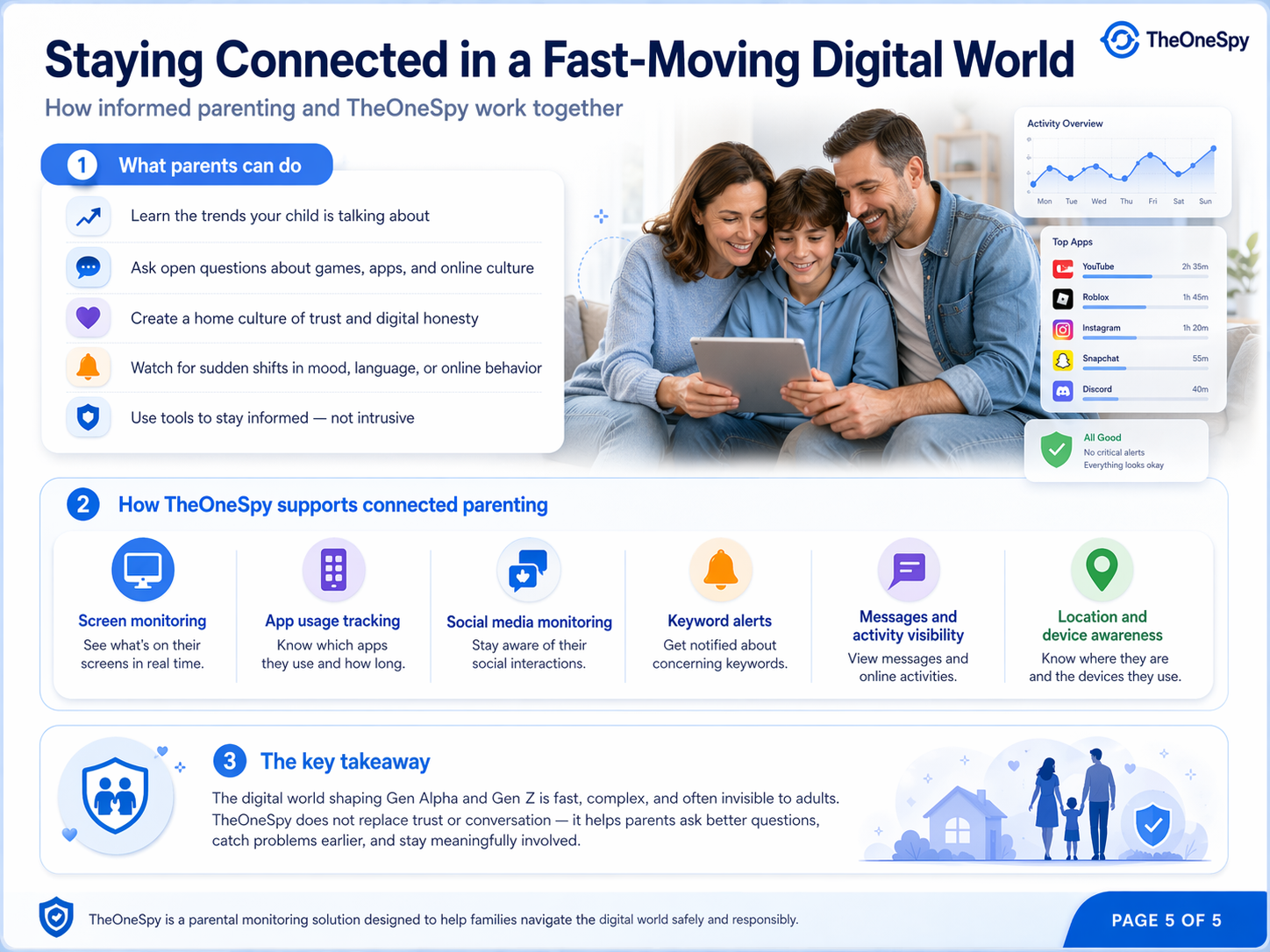
Staying Connected in a Fast-Moving World
The pace at which Gen Alpha and Gen Z culture moves is not going to slow down. If anything, the viral cycle is getting shorter, and the cultural gaps between generations are getting wider. A parent who was fluent in their teenager’s world two years ago may feel completely lost today.
Understanding the trends — the sensory toys, the Roblox games, the eyeliner aesthetics, the identity slang — is the first step. But understanding is only useful if it leads to action. That means having real conversations with your kids about what they are engaging with online. It means creating a home environment where they feel comfortable bringing confusing or uncomfortable things to you. And it means using the tools available to you to stay genuinely informed.
TheOneSpy is designed to support exactly that kind of informed, connected parenting. It does not replace trust or conversation — it enables them. By giving parents visibility into their child’s digital world, TheOneSpy makes it possible to ask the right questions at the right time, catch problems before they escalate, and stay meaningfully involved in a part of your child’s life that increasingly defines who they are.
The world your child is growing up in is fast, complex, and largely invisible to the adults around them. With the right approach and the right tools, it does not have to stay that way.
TheOneSpy is a parental monitoring solution designed to help families navigate the digital world safely and responsibly.