
Almost every screen-time argument in every house is about the same thing: a number. Two hours? Three? The teenager says everyone else gets more. The parent picks a figure that feels responsible. Nobody is happy, and the number changes nothing.
Here’s the part that reframes it. The American Academy of Pediatrics used to publish strict hour limits — and moved away from them, because the hour count turned out to be a poor predictor of harm. Two hours of a kid editing videos with a friend and two hours of doomscrolling alone at 1am are not the same two hours. What predicts harm isn’t the total. It’s what the screen time displaces.
This guide gives you the test that actually works, the four things worth protecting, and what to do when structure disappears — school holidays, summer, half-term — and the whole system falls over.
What the Numbers Actually Say
The scale is real, and worth stating precisely rather than dramatically. Gallup puts the average American teenager at 4.8 hours a day on social media alone — 5.3 for girls, 4.4 for boys. Pew found 36% are on at least one platform “almost constantly.” The U.S. Surgeon General’s advisory links more than three hours a day to roughly double the risk of anxiety and depression.
But sitting alongside that is the finding most parents never hear: 45% of teens say they spend too much time on their phones, and nearly half have already tried to cut back on their own. Your child is not the opposition in this. They are losing the same fight you are — against design teams paid to make it unwinnable. That single fact should change the tone of the conversation, because a child who is quietly failing at self-control does not need a lecture. They need an ally with a plan.
The Test That Actually Works
Screen time is only harmful when it takes something. So stop auditing the number and start auditing the displacement.
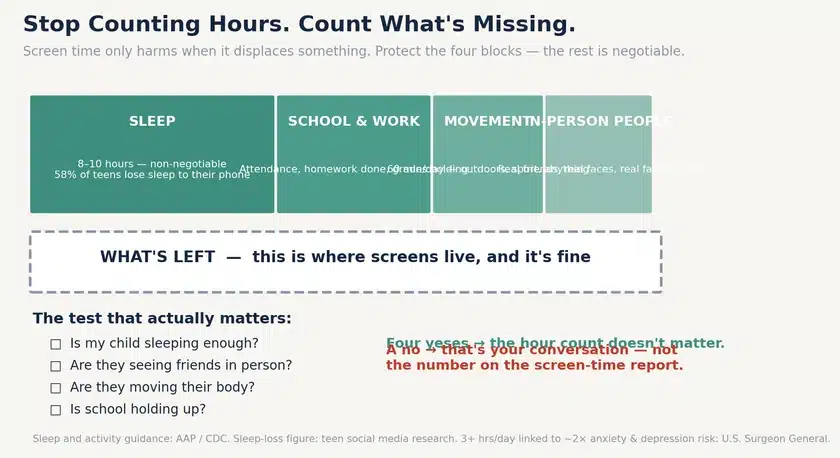
Figure 1 — Protect the four blocks. Whatever is left over is genuinely fine — and arguing about it costs more than it saves.
1. Sleep — the one that isn’t negotiable
Teenagers need eight to ten hours. 58% report losing sleep to social media. If you change exactly one thing after reading this, make it this one: no devices in bedrooms overnight. Buy a cheap alarm clock and charge every phone in the kitchen — yours included, because a rule you don’t follow isn’t a rule, it’s a decree. Sleep is upstream of mood, school, immunity and impulse control. Protect it and half the other problems shrink.
2. In-person people
Not “is my child social” — they may have a rich social life through the phone — but are they in rooms with people? Faces, silences, timing, the small friction of a friend who disagrees. This is the skill that atrophies quietly and shows up years later.
3. Movement
Roughly an hour a day of something physical. It doesn’t need to be a sport. Walking the dog counts.
4. School and responsibilities
Attendance, homework, the job if there is one. A slipping grade is a signal worth reading — though be careful about the causation: sometimes the screen is the cause, and sometimes it’s the anaesthetic for something else that’s wrong.
Four yeses? The hour count is a distraction. Let it go. One no? That’s your conversation — and notice that the conversation is about the missing thing, not about the phone. “You’re exhausted and you’re not seeing your friends” is a discussion. “You were on your phone for six hours” is an accusation, and it ends the same way every time.
Not All Screen Time Is the Same Screen Time
The other reason the number misleads: it flattens completely different activities into one figure. A rough hierarchy, best to worst:
- Creating — making music, editing video, writing code, building in a game. This is closer to a workshop than a screen.
- Connecting — talking with actual friends. Not ideal versus meeting them, but genuinely social.
- Consuming deliberately — a chosen film, a match, a series watched on purpose. Fine.
- Passive infinite scroll — the algorithm choosing, the child absorbing. This is the one linked to the outcomes people worry about, and it’s the one your child least enjoys. Ask them; most will tell you.
So the sharper question isn’t “how long?” It’s “what were you doing, and did you choose it — or did it choose you?” Teenagers hate being manipulated. That question lands where a time limit bounces off.
When the Structure Disappears: Holidays and Long Breaks
School is a scaffold. Remove it — summer, winter break, half-term — and screen time expands to fill the vacuum, which is why every parent notices the same slide during long holidays. Bad weather, no timetable, friends also at home and also online. Nothing has gone wrong; the structure just left.
The mistake is to respond with a crackdown at the exact moment your child expects a break. Better:
- Agree the plan before the break starts, together. A holiday plan negotiated in advance is a deal. The same plan imposed on day three is a punishment — identical rules, opposite outcome.
- Keep sleep fixed, loosen the rest. Let the daytime hours drift. Hold the overnight line. If you defend one thing across a six-week break, defend this.
- Replace, don’t just remove. Boredom is not solved by confiscation — a bored teenager with no phone is just a bored teenager who resents you. Put something in the gap: a day out, a project, friends in the house, a job.
- Protect one screen-free block a day, and join it. A meal, a walk, an evening. Applies to the adults — especially the adults.
- Plan the re-entry. Shift bedtimes back a few days before school restarts, rather than colliding with 7am on day one.
One caution on gifts: a new console or phone arriving at the start of a long break is the highest-risk moment of the year — a new device, no routine, and weeks of unstructured time. Set the terms on day one, while the novelty is doing the negotiating for you.
What to Do About the Phone at Night
Since this is the single highest-return change, the practicalities:
- One charging station, in a shared room. Every device, every night, including the parents’.
- Use the built-in tools — Apple Screen Time Downtime, Google Family Link, Microsoft Family Safety. They’re free, they’re already installed, and for many families they’re enough.
- Expect resistance for about a week. It usually passes faster than you think, and the sleep improvement is visible before the arguing stops.
- If your teen says they need it as an alarm — a clock costs almost nothing, and this is the oldest negotiation in the book.
Where a Monitoring App Fits
Honestly: most families do not need one for screen time. Apple Screen Time and Google Family Link handle limits, downtime and app blocking at no cost, and if that’s your only concern, use those and skip the rest of this section.
What a monitoring app adds is the gap between the screen time your child describes and the screen time that’s happening — across every device rather than one, and with alerts rather than a live feed. TheOneSpy covers Android, iPhone/iPad, Windows and Mac from one dashboard: app-usage patterns, time-of-day data (the 2am sessions you’d otherwise never see), and remote limits you can adjust without holding the phone. Used well it settles arguments with data instead of guesswork — which is the real value, because “you’re always on it” versus “no I’m not” is not a conversation anyone wins.
The conditions, as everywhere on this site: your child knows it’s installed, and it scales back as they grow. And it ranks fourth on this page — behind the overnight rule, the displacement test, and asking what they were actually doing. Those are free.
Frequently Asked Questions
How much screen time is healthy for kids?
There’s no single right number, which is why the American Academy of Pediatrics moved away from strict hour limits. Use the displacement test instead: is your child sleeping 8–10 hours, seeing friends in person, moving their body, and keeping up at school? Four yeses and the total doesn’t matter much. A no is where the conversation belongs.
What’s the most important screen time rule?
No devices in bedrooms overnight. 58% of teens report losing sleep to social media, and sleep is upstream of mood, school performance and impulse control. One charging station in a shared room — including the parents’ phones, because a rule adults don’t follow isn’t a rule.
How do I manage screen time during school holidays?
Agree the plan before the break starts rather than imposing it on day three — identical rules, opposite reception. Let daytime hours drift; hold the overnight line. Replace rather than remove, since confiscation just produces a resentful bored teenager. And set terms on day one for any new device that arrives as a gift.
Is all screen time equally bad?
No, and that’s why the number misleads. Creating (music, code, video, building) is closer to a workshop than a screen. Connecting with real friends is genuinely social. Deliberate watching is fine. Passive infinite scroll — the algorithm choosing, your child absorbing — is the one linked to the outcomes people worry about, and the one teens enjoy least.
My teen says everyone else gets more screen time. What do I say?
They may be right — the average teen is at 4.8 hours a day on social media alone. But the more useful move is to stop defending a number. Show them the four blocks, agree that whatever is left is theirs, and mention the finding that 45% of teens say they’re on their phones too much and nearly half have tried to cut back. They’re not arguing against you; they’re losing the same fight.
Sources
- Gallup — Teen social media time-use survey (average 4.8 hours/day; girls 5.3, boys 4.4)
- U.S. Surgeon General — Advisory on Social Media and Youth Mental Health (2023)
- Pew Research Center — Teens, Social Media and Mental Health (2025); Teens, Social Media and AI Chatbots (December 2025)
- American Academy of Pediatrics — Family Media Plan; shift away from fixed hour limits
- CDC — youth screen time and sleep guidance
- Cyberbullying Research Center — teen cyberbullying prevalence