
Before we could teach them confidence, it taught comparison. Before we explained boundaries, it showed them the algorithm. Before we understood the risks, they were already living in them.
If that lands as a small grief, you’re not being dramatic. Most parents of a teenager have had the same moment: a realization that somewhere between the first phone and now, something else started doing part of the raising. The slang arrived from somewhere. So did the opinions, the humor, the sense of what a body should look like.
But the framing of that feeling matters enormously, because “we lost the race” leads to the two responses that fail: surveillance or surrender. Here is the more accurate version. You didn’t lose a race. The internet took over a part of the job — and it happens to be the part that was never the hard part. What remains is the part it cannot do at all.
What Actually Changed
Be precise about the scale, because the numbers are genuinely different from the ones parents grew up with. Gallup puts the average American teen at 4.8 hours a day on social platforms. Pew found 36% are on at least one platform “almost constantly,” with roughly nine in ten on YouTube. The U.S. Surgeon General’s advisory links more than three hours a day to roughly double the risk of anxiety and depression.
And the shift isn’t only in volume — it’s who is teaching. A recommendation algorithm now decides which ideas your child meets, in what order, and at what age. It has no view on whether a fourteen-year-old is ready. It has one job: to predict what holds attention next. So a girl who pauses on one video about her appearance gets served fifty more. That isn’t a moral failure by your child; it’s a system doing precisely what it was built to do.
The clinical psychologist Catherine Steiner-Adair put the cost of the shift plainly:
As a species, we are very highly attuned to reading social cues. There’s no question kids are missing out on very critical social skills. Texting and online communicating puts everybody in a context where body language, facial expression, and even the smallest kinds of vocal reactions are rendered invisible.
— Dr. Catherine Steiner-Adair, EdD, clinical psychologist and author of The Big Disconnect, via Child Mind Institute
The Division of Labour
Here’s the reframe that changes what you do on Monday morning. The internet is an extraordinary teacher of some things, and structurally incapable of others.
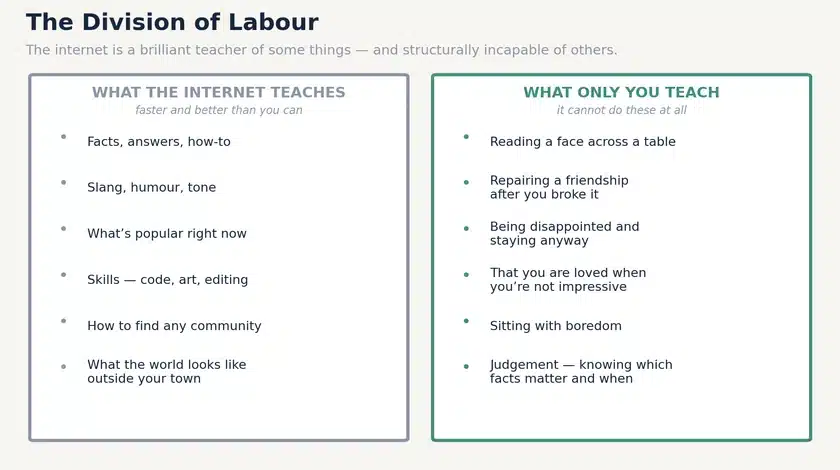
Figure 1 — The left column is real and mostly good. The right column is the whole job — and no algorithm can touch it.
Look at the right-hand column honestly. Not one of those things can be delivered by a feed, a chatbot, or a filter. Repairing a friendship after you were the one who broke it. Being disappointed by someone and staying anyway. Knowing you are loved on a day when you are not impressive. Sitting with boredom long enough for an idea to arrive. Reading a face across a table.
That column is not the consolation prize. It is the job — and it always was. The internet took the information; it cannot take the judgment. Your child can find any fact in four seconds and still have no idea which facts matter, or when, or what to do with them at 2 am when something has gone wrong. That gap is where you live.
Why “They’d Tell Me” Isn’t a Plan
The most common parental strategy is a quiet assumption: if something serious happened, my child would come to me. The research says otherwise, and the reason is not that your child doesn’t love you.
Kaspersky’s global research found 57% of children aged 8–16 have hidden something about their online life from their parents. But the same body of research contains the more useful finding: 75% of children say they would feel safer if they could talk to their parents about the dangers they meet online. They want the conversation. They’ve just done the maths and concluded it will cost them — anger, blame, or the phone.
Pew sharpens it: 80% of parents say they’re comfortable discussing mental health with their teen; only 52% of teens feel that comfort. Most parents believe the door is open. Barely half of teens can see it. Which means the work isn’t opening the door — it’s making it visible.
What Actually Works
Say the amnesty clause before anything happens
One sentence, when nothing is wrong, repeated until it’s boring: if you bring me a problem — even one you caused — my first job is to help, not punish. This is the highest-return thing any parent can do, and it costs nothing.
Protect the right column
Every hour of unstructured, in-person, boring time with actual humans is an hour in the column no algorithm can serve. No devices in bedrooms overnight isn’t a punishment — it protects sleep, which protects everything else. 58% of teens report losing sleep to social media.
Name the machinery out loud
Teach your child the word algorithm — and the question “Did I choose this, or did it choose me?” Teenagers loathe being manipulated. Framed as “look what they’re doing to you,” it lands where a lecture about screen time bounces off.
Be in the room — not just in the settings
Ask them to teach you a platform. Being taught is the lowest-stakes way to open a channel, and it flips a dynamic teenagers are tired of. The parent who has never opened TikTok cannot help their child navigate it — and the child knows.
Scale it to the age, not to your anxiety
Guardrails at eight. Pattern-watching at thirteen. Safety-only oversight at sixteen. Largely retired by eighteen. Scaffolding, not a cage — because the goal isn’t a supervised child, it’s an adult with judgment of their own.
Where Tools Fit
Software belongs in this picture but is low in it — and it’s worth being clear about the order. Conversation first. The free built-ins (Apple Screen Time, Google Family Link, Microsoft Family Safety) are second. Platform settings third. Only then, a monitoring app, and only for a reason you can name.
TheOneSpy phone monitoring sits at that last layer: visibility into app use, screen-time reality versus screen-time promises, location safety, and alerts for the things a child is least likely to volunteer — across Android, iPhone/iPad, Windows and Mac. The condition is the same one this whole article rests on: your child knows it’s there, and it scales back as they grow. A monitoring app used openly is a seatbelt — an unremarkable safety feature nobody argues about. Used secretly, it’s a trap, and it teaches exactly the lesson you don’t want: that you were never safe to tell.
And if a conversation and the free tools cover your family — that’s a win, not a failure. The right column was always the real work.
Go Deeper
This is the overview. The specifics live here:
- Parental controls: the five-layer protection stack — what to set up, and in what order
- How to evaluate any parental control app — seven criteria, and the red flags that mean walk away
- Which monitoring features matter, by age — and which “features” to refuse
- Social media safety settings — the free controls almost no parent turns on
- Is your child hiding something? — normal privacy versus a real warning sign
- Why teens don’t tell their parents — the silence loop, and how to break it
- AI risks: algorithms, chatbots and companions — the friend who isn’t real
- Deepfakes and AI harassment — what no app can fix, and the 48-hour removal right you now have
Frequently Asked Questions
What is digital parenting?
Raising a child whose social and intellectual world runs partly through screens you can’t see. In practice, it means dividing the job honestly: the internet handles facts, skills, and culture; you handle judgment, repair, boredom, and being loved on an unimpressive day. Tools support that — they don’t replace it.
Has the internet really changed childhood that much?
The measurable parts have. The average teen spends 4.8 hours a day on social platforms (Gallup), 36% are on at least one ‘almost constantly’ (Pew), and 3+ hours daily is linked to roughly double the risk of anxiety and depression (U.S. Surgeon General). What hasn’t changed is what children need from adults.
Am I a bad parent if the internet taught my kid things first?
No — and that framing is the problem. The internet is faster at facts, slang, and culture than any parent has ever been. It’s structurally incapable of teaching judgment, repair, or unconditional regard. You didn’t lose a race; a machine took over the easy half.
Should I just take the phone away?
Rarely, and never as the response to honesty. To a teenager, the phone is their entire social world — removing it is an amputation, not a consequence. More importantly, if losing the phone is the predicted cost of telling you something, you’ve priced honesty out of the market. Consequences can follow behavior; they should never follow disclosure.
How much monitoring is too much?
Monitoring is scaffolding, not a cage: heavier at eight, lighter at thirteen, safety-only by sixteen, largely retired by eighteen. If it’s secret, it’s too much at any age — discovery is near-certain, and it costs the trust that makes your child come to you in a crisis.
Sources
- Gallup — Teen social media time-use survey
- Pew Research Center — Teens, Social Media and AI Chatbots (December 2025); Teens, Social Media and Mental Health (2025)
- U.S. Surgeon General — Advisory on Social Media and Youth Mental Health (2023)
- Kaspersky — “Growing Up Online” global survey
- Dr. Catherine Steiner-Adair, The Big Disconnect — via Child Mind Institute
- American Academy of Pediatrics / HealthyChildren.org — digital-age parenting guidance