
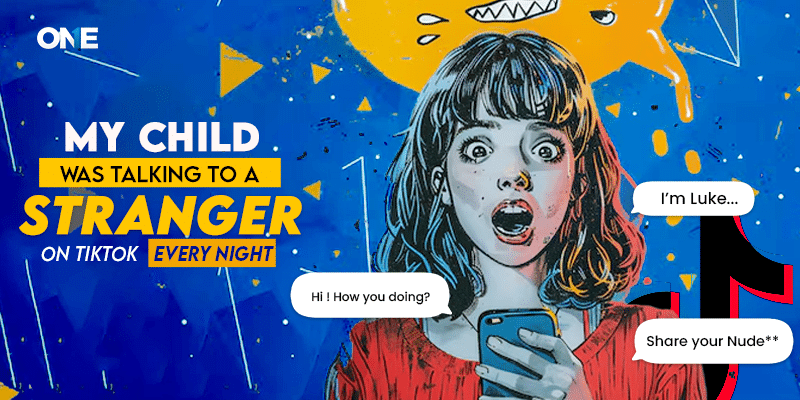
TikTok has 1.5 billion monthly active users. More than half of all teenagers in the United States use it daily. And according to research by Thorn, an organization dedicated to the child protection, 62 percent of minors have received direct messages from someone they did not know on social media platforms.
Parents who rely on TikTok’s built-in parental controls are working with less protection than they think. The platform’s Family Pairing mode limits screen time and restricts certain content. It does not show parents what their child is actually doing, who is messaging them, or what those messages say.
That gap has real consequences. And it is the gap that TheOneSpy’s social media monitoring was built to fill.
The Problem Built-In Controls Don’t Solve
TikTok’s algorithm is exceptionally good at one thing: keeping users engaged. For children, that engagement frequently extends well past bedtime, into the DM inbox, and into conversations with people their parents have never heard of.
The platform’s own safety research has acknowledged that grooming behaviors — adults establishing trust with minors through repeated, low-pressure contact — frequently begin in the DM inbox of social platforms. The initial messages are rarely alarming. They are friendly. Complimentary. They ask about school, interests, and how the child’s day was.
By the time a parent might notice something is wrong, the contact has often been ongoing for weeks. Built-in parental controls do not surface this. Screen time limits do not prevent it. Content filters do not detect it. A parent using only TikTok’s native tools has no visibility into the conversation history in their child’s DMs — only trust that nothing concerning is
happening there.
What TheOneSpy Shows That TikTok Doesn’t
TheOneSpy’s TikTok monitoring and social media monitoring features work by operating on the managed device itself, capturing activity as it happens and syncing it to the parents’ secure dashboard.
This Means Parents Can Review:
Direct message conversations — full message history, including deleted messages, where supported across TikTok and other platforms
Contact details — who their child is talking to, including usernames, profile information, and frequency of contact
Screen recording — a visual record of what the child’s screen showed during use, making it immediately apparent when something unusual is happening
Activity timing — when the child was using TikTok, including late-night sessions. That would not appear unusual in a screen time report
The combination of message visibility and screen activity makes it possible for parents to identify not just that contact is happening, but what the nature of that contact is.
A Scenario Parents Recognize
Consider a twelve-year-old who uses TikTok openly, in the living room, with her parents nearby. Her screen time is within agreed limits. She does not seem secretive. There is nothing in her visible behavior that raises concern.
What a parent using TheOneSpy might discover is that between 10 pm and midnight, after the phone is supposedly put away, a series of DM exchanges takes place with an account whose stated age and whose conversation patterns do not align.
The messages are friendly. Interested. The account asks questions about her school, her schedule, and when she is usually home alone. Nothing overtly threatening — which is precisely why the built-in filters do not catch it.
With social media monitoring active on the device, a parent has the information needed to intervene early. Without it, they have a screen time report that shows everything within normal parameters, and no way to know that it isn’t.
Why This Isn’t About Distrust
Parents who implement social media monitoring are frequently asked whether they trust their children. The question misframes the issue.
A twelve-year-old’s inability to identify grooming behavior is not a failure of character. It is a developmental reality. Children are not equipped to recognize the patient, deliberate manipulation that characterizes predatory contact. Adults are specifically exploiting that developmental gap.
Monitoring in this context is not the surveillance of a child suspected of wrongdoing. It is a parent fulfilling their responsibility to protect a child from an adult threat that the child cannot adequately assess for themselves.
TheOneSpy’s parental monitoring features are designed for exactly this lawful, responsible use — on devices parents own, for children under parental authority.
How TikTok Monitoring Compares
| What Parents Need | TikTok Family Pairing | TheOneSpy |
|---|---|---|
| See DM conversations | ✗ | ✓ |
| Review contact history | ✗ | ✓ |
| Screen recording of activity | ✗ | ✓ |
| Late-night usage alerts | ✗ | ✓ |
| Cross-platform visibility | ✗ | ✓ |
| Activity timestamps | Limited | ✓ |
TheOneSpy plans start from $18/mo, with social media monitoring included across supported plans for Android devices. Full compatibility and plan details are available on the pricing page.
What Parents Can Do Today
The average age at which a child receives their first smartphone in the UK is ten years old. In the US, it is closer to eleven. The average age at which a child first encounters unwanted contact online is twelve.
The window between those two numbers is narrow. The tools most parents are using during that window — built-in platform controls, agreed usage rules, trust — are not designed to detect what is most likely to cause harm.
TheOneSpy’s social media and TikTok monitoring gives parents visibility into that window. Not to police their children, but to protect them from adults who are specifically targeting the space that parental controls leave unmonitored.
Ready to See What’s Actually in Your Child’s DMs?
- View Plans and Pricing — From $18/mo →
- TikTok Monitoring
- Social Media Monitoring
- Screen Recording
- All Parental Control Features
TheOneSpy is for lawful parental monitoring on devices you own or are legally permitted to manage. Use in compliance with applicable laws. See our Terms and Privacy Policy