
Ask a teenager how things are going online and you’ll usually get one syllable. It’s tempting to read that as attitude. It isn’t. When researchers ask young people directly, a different picture appears: 75% of children say they would feel safer if they could talk to their parents about the dangers they meet online. Three-quarters of them want the conversation. They’re just not having it.
That gap — between wanting to talk and actually talking — is the whole subject of this article. Teen silence isn’t defiance. It’s a calculation. And once you understand the maths your child is doing, you can change the answer.
Silence Is a Risk Assessment, Not a Rebellion
Before a teenager tells you something difficult, they run a fast, unconscious cost-benefit analysis: what will happen to me if I say this? They’re not weighing whether you love them. They’re predicting your reaction — based on every previous reaction they’ve seen.
The predicted costs are specific and, from their side, entirely rational:
- Losing the phone. To an adult this is a device. To a fourteen-year-old it is their entire social world — friendships, belonging, the place their life happens. “I’ll take that away” isn’t a consequence; it’s an amputation. A child who believes honesty costs their social existence will choose silence nearly every time.
- Being blamed for it. “Why were you even on that app?” “Why would you send that?” Teens hear the question behind the question: this is your fault. This is why sextortion works — offenders bank on the child’s conviction that the adults will blame them.
- Triggering an overreaction. They tell you about one bad message and you delete every app in the house. They learn that small honest disclosures produce large unpredictable consequences — so they stop making small disclosures.
- Not being understood. If a parent has never used the platform, explaining the problem feels like more work than carrying it.
The Loop That Keeps It Going
None of this is static. Each silence teaches the next one.
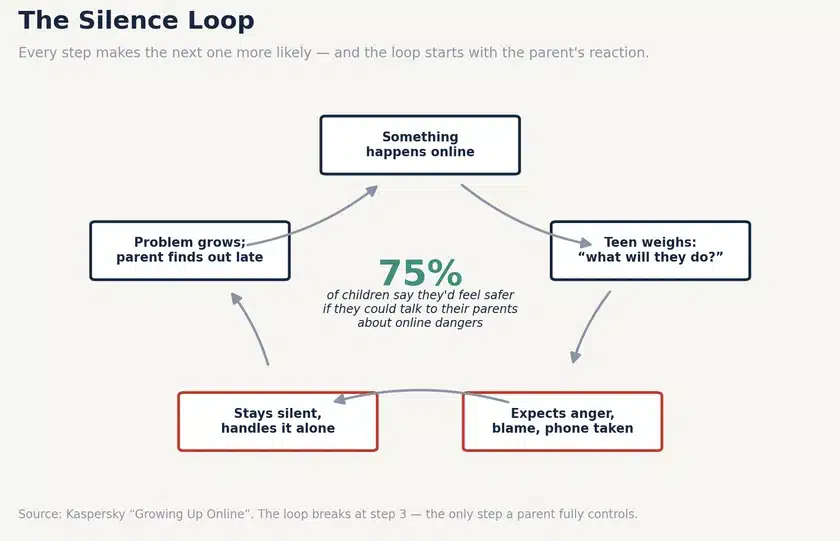
Figure 1 — The loop turns one bad reaction into a lasting pattern. Step 3 is the only step a parent fully controls — and it’s where the loop breaks.
Something happens. Your child predicts the fallout. The prediction says anger, blame, confiscation. So they handle it alone. The problem grows, and by the time you find out it’s bigger and later — which makes your reaction more intense, which confirms the prediction, which guarantees the next silence. Parents often experience this as “my kid never tells me anything until it’s a crisis.” The crisis-only pattern is the loop, running as designed.
Two Numbers That Explain the Gap
Pew Research Center found that 80% of parents say they’re comfortable talking with their teen about mental health — but only 52% of teens feel that comfort. Read those together: most parents believe the door is open. Barely half of teens can see it.
That mismatch matters because it means the failure isn’t usually love or intent — it’s signal. You know you’d respond well. Your child is going on evidence, and the evidence they have is whatever happened the last time someone brought you bad news — including news that had nothing to do with them.
There’s a second reason for silence that has nothing to do with fear: much of what teens encounter online doesn’t register as reportable. Cruel comments, unsolicited images, casual harassment — when these are routine, they stop looking like events worth mentioning. Roughly three-quarters of teens say harassment is a problem for people their age on the platforms they use. A child doesn’t report the weather.
How to Break the Loop
1. Say the amnesty clause out loud — before anything happens
One sentence, said when things are calm, repeated until it’s boring: if you bring me a problem — even one you caused — my first job is to help, not punish. This is the single highest-value thing in this article. In sextortion cases it is the difference between a child who tells you on day one and a child who pays a blackmailer in silence for months.
2. Decouple honesty from losing the phone
Make it explicit: telling me something never costs you your phone. Consequences may follow behaviour; they never follow disclosure. If the only tool your child expects is confiscation, you’ve priced honesty out of the market.
3. Control your first ninety seconds
Your face is the data. Whatever you feel — and you will feel it — the first ninety seconds decide whether they finish the story or shut it down. “Thank you for telling me. Let’s work out what to do” buys you time to have your own reaction later, out of the room.
4. Talk when nothing is wrong
If the only time you ask about their online life is when you’re worried, every question sounds like an investigation. Ask about the funny thing they saw. Let them explain a platform to you. Side-by-side beats face-to-face — a car, a walk, washing up. Low stakes build the channel you’ll need at high stakes.
5. Name the specific risks, so they can recognise them
Two-thirds of young people have never heard the word sextortion. You can’t report a trap you don’t know exists. Explain plainly how it works, that it targets boys aged 14–17 most, that offenders are organised adults — and that the child is never the one at fault. NCMEC logged over 50,000 financial sextortion reports in 2025, roughly 137 a day.
What a Monitoring App Can — and Can’t — Do Here
It’s worth being blunt about the limits of software on this particular problem, because the logic matters. If your teen is silent because they fear being watched and judged, then watching them secretly doesn’t solve the silence — it proves them right. Discovery is near-certain, and the cost is the exact thing you were trying to build.
What monitoring can honestly offer is a second channel while you rebuild the first. TheOneSpy’s alerts — an unknown contact appearing, keywords tied to bullying or self-harm, a sharp change in activity — can surface a problem your child hasn’t found words for yet, across Android, iPhone/iPad, Windows and Mac. But that only helps if it’s installed openly, explained honestly, and scaled back as they grow. Used that way, an alert becomes an opening: “I noticed something and I’m worried — talk to me.” Used secretly, it becomes the evidence that you were never safe to tell.
And the honest hierarchy: the amnesty clause is free and works better than any dashboard. Start there.
Frequently Asked Questions
Why won’t my teenager tell me what’s happening online?
Usually because they’ve predicted the outcome and it looks bad: losing their phone, being blamed, or triggering an overreaction. It’s a risk assessment, not defiance. 75% of children say they’d feel safer if they could talk to their parents about online dangers — the wish is there; the safety signal isn’t.
How do I get my teen to open up about online problems?
Say the amnesty clause before anything happens — ‘bringing me a problem, even one you caused, gets help not punishment’ — and mean it. Decouple honesty from losing the phone, control your first ninety seconds of reaction, and talk about their online world when nothing is wrong.
My teen says I don’t understand the internet. Are they right?
Partly, and that’s fixable. If you’ve never used the platform, explaining a problem on it feels like more work than carrying it alone. Ask them to show you how it works — being taught is a low-stakes way to open the channel, and it flips the dynamic in a way teens respond to.
Should I monitor my teen’s phone if they won’t talk to me?
Openly, perhaps — secretly, no. If silence is driven by fear of being watched and judged, covert monitoring confirms that fear when discovered. Transparent alerts can surface a problem your teen can’t voice yet, but they work alongside rebuilding trust, not instead of it.
What if my teen tells me something serious?
Your first ninety seconds decide whether they finish. Thank them, stay calm, and act — not react. For sextortion: stop contact, never pay, save evidence, report to police and NCMEC’s CyberTipline. If there are signs of self-harm, call or text 988. Save your own emotional reaction for later, out of the room.
Sources
- Kaspersky — “Growing Up Online” global survey (75% of children would feel safer talking to parents about online dangers)
- Pew Research Center — Teens, Social Media and Mental Health (2025): 80% of parents vs 52% of teens report comfort discussing mental health
- Pew Research Center — Teens’ Experiences on TikTok, Instagram and Snapchat (2026)
- NCMEC — CyberTipline financial sextortion data (2025–2026)
- Thorn — youth sextortion awareness research (2025)
- American Academy of Pediatrics / HealthyChildren.org — digital-age parenting guidance