
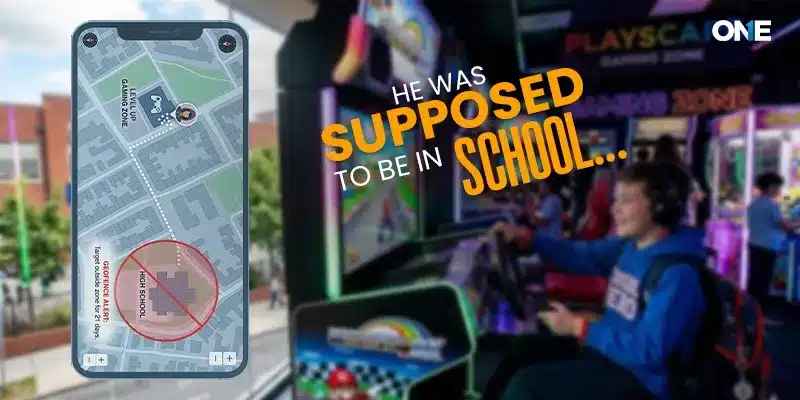
Chronic absenteeism — missing ten percent or more of the school year — now affects an estimated 26 percent of students across the United States. That is roughly 13 million children. And in a significant proportion of cases, parents are the last to find out.
Schools send notifications. Automated calls go to numbers that ring at inconvenient times, are missed, or are intercepted by the student themselves. By the time a parent receives an official attendance report, a pattern that took weeks to establish is already Entrenched.
The connection between unexplained absences and serious outcomes is well-documented. Chronically absent students are significantly more likely to fall behind academically, disengage from education entirely, and, in higher-risk environments, become involved with substance use or peer groups engaged in problematic behavior.
TheOneSpy’s geofencing feature gives parents a way to know — immediately, not weeks later — when their child leaves a designated safe area during hours when they should be
there.
What Geofencing Actually Does
Geofencing works by establishing a virtual boundary around a physical location on the map — in this context, the school building and its immediate surroundings. When the managed device crosses that boundary during defined hours, the parent receives an Alert.
This is different from simply tracking a child’s location. Location tracking tells a parent where their child is when the parent chooses to check. Geofencing alerts a parent the moment something changes — without the parent needing to remember to look.
For school attendance specifically, this means:
- A parent is notified when their child leaves school grounds mid-morning
- A parent is alerted if their child never arrives at school at all
- Multiple geofences can be set — home, school, sports facility — creating a broader
- A picture of whether a child is where they are supposed to be
The real-time GPS location data that accompanies the alert tells a parent not just that their child has left school, but where they are instead.
The Truancy Problem Parents Don’t See Coming
Truancy rarely begins dramatically. It typically starts with a single missed morning — a test the child was not prepared for, a social conflict they were avoiding, a day when the The pull of staying home was simply stronger than the pull of going.
If that absence produces no visible consequence — no parental response, no school A follow-up that reaches the parent increases the probability of a second absence. Research from the Journal of School Health documents this escalation pattern clearly: the majority of chronically absent students began with isolated absences that went unaddressed.
A parent who receives a geofencing alert on the first day their child skips school is in a fundamentally different position from a parent who discovers it three weeks later. Early intervention — a conversation, an investigation into what is wrong — changes the Outcome. Late discovery does not.
A Scenario That Repeats Across Schools
Consider a fifteen-year-old who tells his parents he is going to school each morning. He leaves the house at the right time. He comes home at the right time. His phone shows normal activity throughout the day. His parents have no reason to question the routine.
What a parent with TheOneSpy geofencing active would know: that the device leaves the school premises consistently by 9 am and does not return. The GPS data shows the device spending the school day in a park, a friend’s house, or a shopping area three kilometers from school.
What those parents would also have: the ability to respond immediately, when the The pattern is new, rather than when it becomes a three-week problem with academic consequences already in place.
What Geofencing Cannot Do — and What Complements It
Geofencing is a location-based alert. It tells parents where a device is, not why it moved. A child who leaves school early may be unwell, or may be in genuine distress about something happening there.
The geofencing alert is the starting point for a conversation — not a conclusion. Parents who investigate the reason behind an unexplained absence frequently discover something addressable: bullying, academic anxiety, a conflict with a teacher, or social difficulties. These are solvable problems that remain invisible without early detection.
For parents who want visibility beyond location, TheOneSpy’s call monitoring and SMS monitoring can provide additional context — who the child is in contact with during unaccounted hours, and what those conversations look like.
| Feature | Manual GPS Check | TheOneSpy GEOFencing |
|---|---|---|
| Know child left school | Only if the parent remembers to check | Immediate alert |
| See where the child went | ✓ (if check happens) | ✓ (with alert) |
| Alert on first absence | ✗ | ✓ |
| Multiple location zones | ✗ | ✓ |
| Works without parent action | ✗ | ✓ |
Pricing and Getting Started
Geofencing is included in TheOneSpy plans starting from $18/mo. Multiple geofences can be configured, with location alerts delivered directly to the parent’s dashboard. See the full pricing page for plan details and compatibility.
The First Absence is the One That Matters
Schools are not equipped to catch every truancy event and escalate it to parents in real time. That is not a criticism — it is a resource reality. The parent who builds their own early-warning system is not duplicating the school’s effort; they are filling a gap the school cannot close.
TheOneSpy’s geofencing feature is that early-warning system. An alert on day one is worth more than a report on week three.
- Know Immediately — Not Weeks Later.
- View Plans and Pricing — From $18/mo →
- Geofencing / Mark Safe Areas
- GPS Location Tracking
- SMS Monitoring
- All Parental Control Features
TheOneSpy is for lawful parental monitoring on devices you own or are legally permitted to manage. Use in compliance with applicable laws. See our Terms and Privacy Policy.