October is known as National Bullying Prevention Month, and schools in the United States are raising their Voices against online bullying and educating about prevention methods. However, before we dive into prevention methods, parents should know what cyberbullying is. Bullying online is a global problem that’s growing fast. In this particular blog post, we will take you to the top forms of cyberbullying. It would further help you out to protect your children. We are going to discuss the major forms of online bullying that can make your child a victim of online predators.
What is Cyberbullying?
The use of digital communication in terms of cellphones and the internet to make someone angry or provoke anyone to get a cruel, sad, or sarcastic response back and forth is known as cyberbullying. So, online bullying comprises sending hurtful messages, text messages, instant messages, posts, sharing someone’s private photos, videos on social networking, and last but not least, spreading rumors against someone online to damage the reputation of the target is known as cyberbullying.
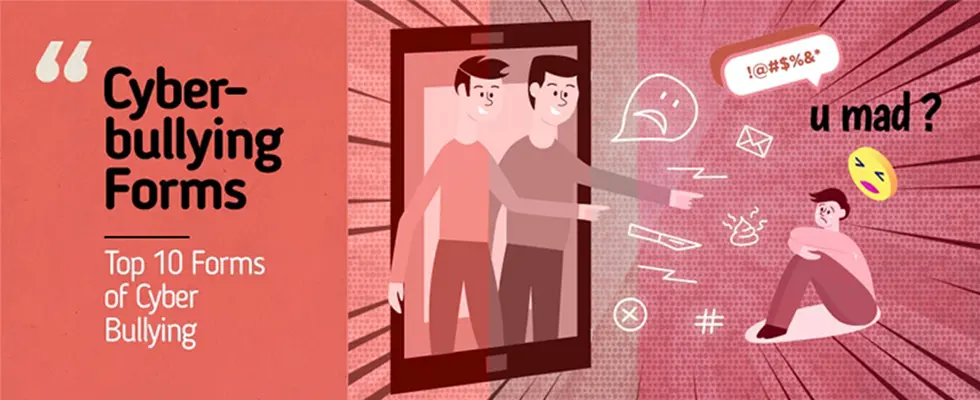
Top 10 Forms of Cyberbullying
There are the following forms of cyberbullying that parents need to know, and they can advise kids about them to prevent themselves from online abuse to the fullest.
Exclusion

Put a stop to cyberbullying and protect your children from all kinds of online predators. Use cell phone parental monitoring software and make sure that your child is safe online fully. Most of the parents who ignore are reportedly kept themselves bitching because of their irresponsibility. Be a responsible parent and protect your teens and kids from cyber predators.
Harassment

It is continuous and intentional bullying that leads to abusive and threatening text messages sent to your kids or the group. This can have serious effects on a child’s mental bullying.
Outing

It is an act of openly embarrassing a child or group through the online posting of private or embarrassing information without asking the victim. Even reading your child’s text messages out loud is known as an outing.
Cyberstalking

It is one of the most dangerous forms of cyberbullying in which attackers threaten victims through social communications such as email, social media apps, and instant messengers. It also comprises adults using cyberspace to contact and meet young kids and teens for abusive aims.
Fraping

It means when anyone gets ingress to your child’s social media account and then pretends to be your child and posts inappropriate content on their behalf. Parents should keep in mind that everything humiliating or posted online can never be fully gone, no matter what is deleted.
Fake Profiles

Fake profiles can be created to hide someone’s real identity to make a child a victim of cyberbullying. Online bullies can use someone else’s email, social media platforms, and mobile phones to harass them.
Dissing

It means sending or posting inappropriate information about your child online to damage their reputation and their friendships. It also includes posting damaging photos, screenshots, or videos online.
Trickery
 It involves winning your child’s trust initially so that the secrets can be shared publicly online. Cyberbullying will defend your child in front of others, leading him into a false sense of security before sending their secret information to others.
Trolling
 It means willingly ousting someone’s response through the use of humiliation on social media and instant messaging apps. A trolley will encounter your child to make them angry and tease them to get a negative response.
Cate fishing
 It means grabbing someone’s online identities and then reestablishing social networking profiles for dodging purposes. So, catfishers look at your child’s social media profiles and steal information to create a fake image. This could involve using personal information vulnerable to damaging your child’s online reputation.
What Is The Relation Between Traditional Bullying & Online Bullying?
A new study from the University of Florida says that 80% of the students are cyberbullying victims. They are more likely to experience bullying at school as well. Boys and girls who used to troll their fellows at school are more likely to engage in bullying on the web. It means that traditional bullies have adopted technology to extend their activity using verbal and non-verbal tactics.
Cyberbullying laws that parents need to know
Laws related to online bullying are different from state to state worldwide. Governments worldwide have come up with serious concerns about cyberbullying, and they have introduced new laws. COVID-19 has increased online bullying because kids and online predators are spending more time in the digital world. The
eSafety Commissioner in Australia has unveiled the stats given below:
- 1 out of 5 kids in Australia becomes the victim of harassment online via social networks
- 20% of Australian kids become witnesses and are involved in bullying online
- Every young online bully has experienced cyberbullying one way or another
- 55% of Australians become the victim of online abuse and solicitation, and 38% blocked the online predators
- 28% of kids have received advice from parents after interaction with cyber predators
- Only 12% of the kids have reported on social media authorities
The Australian authorities have announced that there are no legitimate laws related to bullying online. The government has advised that young kids should keep logs of bullying that takes place on social media or somewhere else. It would help to prosecute the culprits under the Criminal Code, 1955, related to telecommunication crimes.
According to the Statistics
The adoption of social media and technology all across the globe has finally opened the doors for a new type of bullying that is known as online bullying. The online harassment these days is one of the biggest concerns for parents due to the following reasons.
- It can happen around the clock
- The new type of bullying or cyberbullying could last longer because things these days are associated with only posting, which can remain longer.
- The detection of cyberbullying or harassment is very difficult, unlike bullying, which happens under complete silence, which makes it harder for parents to know about it.
Cyberbullying is a continuous problem
Almost 95% of the teens are connected to cyberspace, and 85% of teens are on social media apps and websites, according to the study of PEW Research Center. Seemingly, it is a good sign that teens are getting enough knowledge from the internet. However, at the same time, teens are more likely to get engaged or have encounters with harmful interactions and online bullies.
Almost 73% of young students believe that at some point of they got bullied online, and 44% say it happened in the last 30 days.
Where do teens mostly get bullied online?
- 42% of the teens got bullied online on the Instagram social messaging app
- 37% of teens encounter cyber predators on Facebook
- 31% of kids have experienced digital bullying using Snapchat
- 12% of the youngsters have faced bullying online on WhatsApp instant messenger
- 10 % of teens on YouTube and 9% become the victims of harassment on Twitter.
According to StopBullying.gov, 69% of people have bullied someone in the cyber world. However, 15% have admitted that they bullied people online.
Effects of cyberbullying on kids
- 41% of the victims have social anxiety
- 37% have developed depression
- 26% have suicidal thoughts in mind
- 26% have removed their social media profiles
- 25% have harmed themselves by being a victim of online predators
- 9% have become substance abusers
Bullying online is a massive social problem
The very interesting thing about it does not remain exclusive to teens only; these days, adults have also become the victims of cyber predators. However, bullying in the cyber world is specifically associated with teens and children because they cannot help themselves, but adults can. Let’s get to know about the forms of cyberbullying that give you the knowledge to protect teens.
Is There Any Ratio Difference Between Boys & Girls Cyber Bully Victims?
Yes, there is a little ratio difference between the girls and boys victims of online bullying. A few experts believe that boys are more likely to become the victims of cyberbullies. However, few say teens are the victims of bullies online compared to young boys. Look at the following stats!
Pew Research Center stats:
- 60% of young girls experience cyberbullying one way or the other
- 59% of young boys become the victim of online bullies via different online mediums
The difference lies between the forms of bullying: Boys VS Girls
- 39% Girls face humiliating rumors about them online, like being lesbian
- 26% boys face false rumors about them, like Gays & transgender people
- 29% of young teens receive random sexually explicit messages
- 20% of boys receive explicit messages & images
According to the Swedish study, teens are more likely to become cyberbullying victims because of their physical appearance. It means that gender does not differentiate in becoming a victim of cyberbullying. The study has further added that people belonging to the lower-income class, LGBTQ, and obsessed with the digital world are more likely to become the victim of online predators.
How do I protect my young child from cyberbullying?
When kids and teens have grown enough and can make communication via writing, texting and to use digital devices, kids at the end of the day got plenty of opportunities. They tend towards social media platforms and instant messengers on their digital phones and tablets connected to cyberspace.
However, they still are not able to know online behavior and won’t know when civility online is a duty and when it is a trap. So, they are more likely to get trapped by the cyberbullies. So, parents should guide them about online dangers and online predators in particular. Therefore, parents should do the following things to protect their children from bullying online.
- Parents should have an alternative and provide them with age-appropriate entertainment.
- Parents should teach teens and kids what to share and what not to share in terms of information.
- Set parental control on kids’ and teens’ online activities, especially social media apps, instant messengers, and text messages.
- Parents can guide kids who don’t hide any incident related to online harassment from their parents
- You can teach your kids not to respond to the bully’s random messages, images, and verbal and non-verbal harassment
- Parents need to teach kids not to remove the logs of the online bullying conversations and share them
- Don’t allow your kids to use cellphones and tablets late at night, and keep devices at a distance
- You can teach your kids to put their social media profiles in custom mode
- Don’t share your private photos and videos with strangers
Is there any way to make sure my child won’t become a cyberbully?
If you’re concerned parents that your child won’t become a bully online, then you can do it easily. You have to provide your kids with age-appropriate media. You need to discuss what online responsibility is and supervise their activities online. It would help you out to know what your child does online in terms of chatting, sharing, and receiving as well. Make sure to tell them about the consequences if they bully someone online and get got there will be charge on them according to the law. Mostly bullies are frustrated, that’s why they want to release their frustration and anger. So, parents need to relax and sort out their issues.
When should parents intervene in a cyberbullying situation?
Teens and kids, most of them remain silent even when they are being bullied online or in real life for months. They feel ashamed or get scared while talking to their parents. They usually think that if they tell their parents, then the problems will be worse. So, parents have to know whether kids or teens are normal or if they have issues with cyberbullying. Parents can see the signs that their children are the victims of online predators. Your child starts living, they’re lonely, remain frustrated, and start skipping school, have low school grades, and are often found worried, even skipping their meals. This is the time when parents should intervene and ask their child in a friendly way. However, you can monitor kids’ cell phones and tablets to keep the logs of their online activities in terms of social media, in particular, messages, calls, and multimedia shared over social platforms.
Is there any connection between cyberbullying & suicide?
Over the years, cyberbullying statistics have reportedly stated that there are plenty of cases in which a teen’s suicide is associated with cyberbullying. I know in rare cases teens get suicidal thoughts because of being bullied, but teens and kids who bully or bully someone in real life or in the cyber world are more likely to commit suicide. Cases are cases in which a kid or teens already have got mental stress, depression, and additionally bullying online causes serious issues in terms of suicide. Therefore, parents are aware of the fact that online bullying can ruin their child’s life. So, they should keep an eye on their digital activities and their surroundings. They should keep looking in their social media and other sorts of cell phone activities to know what is going wrong in their lives while having an online presence.
How common is cyberbullying?
It is very difficult to say how much cyberbullying has prevailed in society, whether it is online or offline. Even the definition changes from time to time but one thing that is common among all the victims that they are obsessed with cellphones, tablets, and as well as with the social media websites, apps, and instant messengers. Most of the bullying online victims are used to sharing their privacy in terms of photos, videos, name, cell phone contact, home address, and interacting with strangers whom they hardly know online. That’s why experts believe that cyberbullying has become common in the cyber world, social media platforms in particular. So, parents have to keep an eye on their children’s activities online.
Solution:
Put a stop to cyberbullying and protect your children from all kinds of online predators. Use cell phone parental monitoring software and make sure that your child is safe online fully. Most of the parents who ignore are reportedly kept themselves bitching because of their irresponsibility. Be a responsible parent and protect your teens and kids from cyber predators.