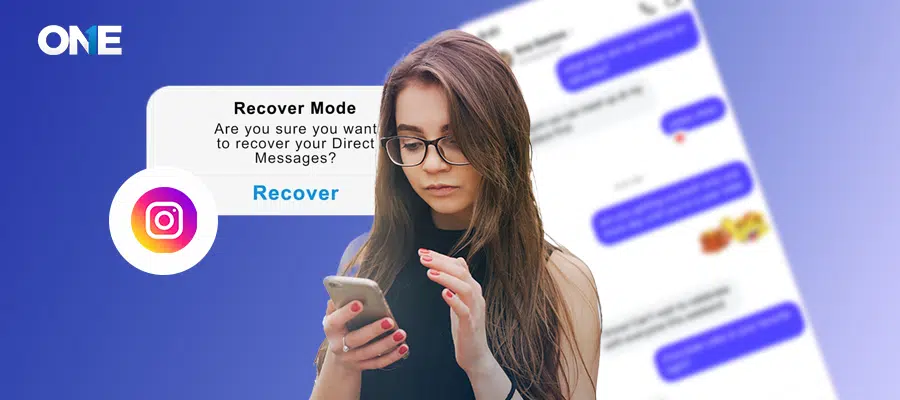
Most guides on this topic promise more than Instagram allows. Some claim any deleted DM can be pulled back within 30 days. Others advertise apps that “recover unsent messages” for a fee. Both are misleading, and following that advice usually costs people money or their account credentials.
Here is the accurate position in 2026: some deleted Instagram messages can be retrieved, and some are gone permanently by design. Which category yours falls into depends entirely on how the message disappeared — and almost nobody explains that first, which is why so many people waste time on methods that were never going to work.
Start here: which kind of deletion happened?
Instagram has three separate mechanisms that make messages vanish, and they behave completely differently. Identify yours before trying anything.
| What happened | Who lost the message | Recoverable? |
|---|---|---|
| Delete for You — you removed it from your own view | Only you | Yes — the other person still has the full thread |
| Unsend — the sender removed it for everyone | Both parties | No — not through Instagram |
| Vanish mode — the chat was set to disappear | Both parties | No — ephemeral by design |
If you deleted a conversation from your own inbox, you are in the easy case. If someone unsent a message, or the chat was in vanish mode, no legitimate method will bring the content back — and any tool claiming otherwise is selling something that does not work.
Method 1: Ask the other person
Unglamorous, and by far the highest success rate for “Delete for You” deletions.
When you delete a conversation from your side, it is removed from your inbox only. The other participant still has the entire thread, exactly as it was. A screenshot or forwarded message takes them thirty seconds.
Before that, check three places where conversations hide rather than disappear:
- Archived chats — conversations you archived are not deleted, just moved
- Message requests — messages from people you don’t follow are filtered here
- Hidden requests — Instagram’s spam filter catches more than people expect
Method 2: Android notification history
This is the only method that can sometimes surface the content of a message that was unsent, and it works because the text was captured by your phone before Instagram retracted it.
On Android 11 or later: Settings → Notifications → Notification History.
The limitations are significant, and most articles gloss over them:
- It must have been switched on beforehand. Notification History is off by default and does not log retroactively. If you enable it now, it does nothing for yesterday’s message.
- Preview text only. You get the first line or a truncated excerpt — whatever appeared in the notification. Android does not store the full message behind it.
- Received messages only. Messages you sent never generated a notification on your own device.
- Roughly 24 hours. Entries are overwritten as new notifications arrive.
- No media. Photos, voice notes and videos won’t be readable.
- Android only. iOS provides no equivalent, and no app can add one.
Realistically this is a partial glimpse rather than a recovery method. When it works, it works well; it just requires you to have prepared in advance and to check quickly.
Method 3: Download Your Information
Meta’s official data export gives you what its servers still hold on your account.
Instagram → Settings and activity → Accounts Center → Your information and permissions → Download your information. Select your Instagram account, choose Messages to keep the file manageable, request it, and wait — delivery ranges from a few hours to a few days.
What this will and won’t do matters:
- Will include conversations still stored against your account, including some you removed from your own view.
- Won’t include unsent messages. They are removed from the servers, so they aren’t in the export.
- Won’t include vanish mode content. It was never retained.
You’ll find message data in JSON files inside the archive. It is not pretty, but it is searchable.
What cannot be recovered — and why
Being direct about this saves people from scam tools.
Unsent messages. When a sender unsends, the message is removed for both parties. Instagram provides no recovery path, and it does not appear in your data download. Meta may retain limited data for safety, moderation or legal compliance — if a message was reported before being unsent, for instance — but none of that is accessible to you as a user.
Vanish mode messages. Designed to disappear once the recipient views the chat and closes it. Not retained on Meta’s servers in a retrievable form. No export, notification log or third-party tool changes this.
Messages from deleted accounts. When an account is fully deleted rather than deactivated, its message data goes with it.
Three myths worth clearing up
“Recently Deleted will restore my DMs.” It won’t. Instagram’s Recently Deleted folder covers posts, Reels and IGTV for 30 days, and Stories for 24 hours. Direct messages are not included at all — there is no DM equivalent.
“I’ll check Facebook Messenger.” Meta discontinued cross-app messaging between Instagram Direct and Messenger in December 2023. The inboxes no longer sync, so Messenger won’t hold a copy.
“This app recovers unsent Instagram messages.” Treat every one of these as a scam. Unsent content is not on your device or on any server you can reach, so there is nothing for an app to find. These tools typically demand broad device permissions or your Instagram login, which is how accounts get compromised. If a tool claims it can retrieve messages that were unsent or sent in vanish mode, it is describing something technically impossible.
For parents: what monitoring software can and cannot do
Many people searching this are parents who noticed their child’s messages disappearing. This section needs to be precise, because the marketing in this category is frequently dishonest — including, until recently, an older version of this article.
What monitoring software cannot do: retrieve a message that was deleted before the software was capturing. No parental control product can reach into Meta’s servers and pull back content, and none can recover an unsent or vanish-mode message from the past. Any product promising to show you “all deleted messages, instantly” is making a claim it cannot honour.
What it can do: capture activity on the device as it happens. If monitoring is active when a message arrives, that content can be recorded at the moment of delivery — which means it may still be visible to a parent even if the sender unsends it afterwards. The distinction is timing: capture at delivery, not recovery after the fact.
That is a real capability and a genuinely useful one. It is also the honest limit of it.
TheOneSpy’s Instagram monitoring works this way, and it is built to be used with the child’s knowledge. That condition isn’t a legal formality — it is what makes the arrangement work. A teenager who agreed to monitoring will come to a parent when something goes wrong. One who discovers hidden surveillance moves to a second account the parent doesn’t know exists, which leaves everyone worse off than before.
The better question for parents
If the concern is what a teenager is deleting, retrieval is the wrong frame to reach for.
Instagram is built to make messages disappear. Unsend has no time limit, vanish mode is one swipe away, and second accounts are free. Any strategy that depends on capturing everything will eventually fail against a platform designed the opposite way.
The questions that hold up better are simpler. Does your child know they can tell you if an adult messages them, without the phone being taken away? Do they know what grooming looks like before it starts? Have you talked about who can message them and how to restrict that in Instagram’s own privacy settings?
Practical measures worth more than any recovery method: set the account to private, restrict message requests to followers only, turn off activity status, and review the follower list together. Our guides to the warning signs of grooming and what to do about sextortion cover the patterns that matter most.
Common questions
Can you see deleted Instagram messages?
Sometimes. Messages you deleted from your own view still exist on the other person’s side. Messages that were unsent or sent in vanish mode cannot be retrieved by any method.
Does Instagram keep deleted messages for 30 days?
This claim is widely repeated and misleading. Instagram’s 30-day Recently Deleted window applies to posts, Reels and IGTV — not direct messages. Meta may retain some data for legal and safety purposes, but that is not accessible to users and it does not mean unsent DMs can be restored.
Will unsent messages appear in my Instagram data download?
No. Unsent messages are removed from Instagram’s servers, so the export won’t contain them. The download reflects what Meta still holds at the time you request it.
Can iPhone users see unsent Instagram messages?
No. iOS provides no notification history equivalent, and no app can add one. iPhone users are limited to the data download and asking the other person.
Does Instagram notify you when someone unsends a message?
No. The message simply disappears from the thread with no alert or placeholder in the chat.
The bottom line
Whether a deleted Instagram message can be seen again depends on one thing: how it was deleted. If you removed it from your own view, the other person still has it — ask them. If it arrived on an Android phone in the last day and you had notification history enabled beforehand, you may catch a fragment. Beyond that, the data download is your only official route, and it will never contain unsent or vanish-mode content.
Everything else marketed as Instagram message recovery is either a misunderstanding of how the platform works or an outright scam. Knowing the difference is worth more than any tool.