In this world, it is impossible to survive without the internet. The Internet covers all the crucial parts of our lives. We can use it to communicate with ur friends and family members, and to explore the world with a single device. Plus, to get the work done remotely, to shop online, and to express your thoughts and ideas. Grateful to the technologists for introducing the advanced digital methods, but some online trends that come with the risks we should never ignore.
One Of The Emerging Challenges Faced Today Is Doxing.
Most internet users don’t even know what doxing means till this kind of violation happens to them or someone close to them. One harsh conversation on social media, a leaked password, or even an old post may be the reason one’s private data is leaked online to strangers.
The fact is, doxing is dangerous because it usually starts secretly. Doxing happens secretly; people rarely notice their personal information being gathered and spread across the internet.
In this post, we will discuss what doxing is, the actual definitions, the damages that are done through it, and how it affects the victims emotionally and physically. Examples of this scam and how you could protect yourself from the vulnerable doxing.
What Does Doxing Mean?

Doxing is when some other person collects your personal sensitive information and shares it over the internet without your consent.
Originally, doxing took the form of dropping documents. At first, hackers meant leaking the victim’s confidential papers, but over time, doxing became the term to denote exposing any of the victim’s private information online.
Such personal information may include:
- Full name
- Address
- Phone number
- Email accounts
- Details of employment
- Information about the family
- Private financial information
- Accounts in social networks
- Location
- Photos or chats
As we mentioned above, doxing always involves exposing this data with the purpose of humiliation, blackmail, intimidation, etc.
Unlike most other cybercrimes, doxing often leads to the intersection of virtual and actual spheres of influence because one’s safety can be seriously endangered.
Why Is Doxing Such a Growing Threat in Modern Days
10 years ago, gathering enough personal data about anyone was rather complicated and labor-intensive. Today, most people tend to share personal data online voluntarily.
Each post on social media, shopping order, game, location check-ins, and account registrations are just some of the sources of personal information that one can easily obtain today. Furthermore, cyber criminals nowadays are capable of using:
- Huge amounts of breached data
- Databases
- Information available on social media
- Tracking applications
- Artificial Intelligence-based search engines
- Credentials for sale online
The combination of all the above factors makes it possible for anyone to dox others.
Another factor that should not be overlooked is the ignorance of what people publicly share on the internet. Even posting about your birthday or tagging the location where you celebrate the holiday, someone can figure out who you are.
Lastly, the growing trend of the itinerant is also a huge factor. The internet culture is one where different people argue from different perspectives, play different games, and share political views. Still, these can be the reasons for someone with bad intentions to attack you for the sake of revenge. It is also worth noting that modern doxing no longer requires advanced skills.
What Is the Process of Doxing?
Most people assume that doxing involves a very complicated hacking technique using state-of-the-art technology. In fact, doxing requires mostly information collection rather than advanced hacking.
Here is how it works in most cases.
Oversharing on Social Media
The most obvious way for doxers to gather private information about someone is to browse their social media profiles and posts.
A person might inadvertently share their:
- Pictures near their home
- Live stories while traveling
- School uniform
- Workplace location
- Personal documents
- Date of birth, pet name, family details
It can also happen that the background of their picture will give away enough clues regarding their identity or location, like the image of a street sign, house number, school logo, or employee badge. Doxers tend to monitor years of activity on social media platforms and gather information little by little.
Data Breaches and Leaked Databases
Currently, the most common reason for personal data leaks is an increasing number of data breaches in organizations and companies. Whenever there is a hacker breach, all users’ information becomes exposed. It could contain:
- Email address
- Password
- Phone number
- Billing information
- Home address
The stealing of others’ information is misused and sold on illegal forums or websites. According to the identity theft research, data theft cases increase every year, and the exposure of personal information threatens people.
Regardless of what you do online, your information is still spread due to the weak security protocols at the company that stores your data.
Phishing and Social Engineering
Sometimes, doxers manipulate their victims and trick them into leaking their own information. There are many ways for phishing to be conducted, including:
- Using a fake login page
- Sending fraudulent emails
- Organizing fake giveaways
- Using impersonation tactics
- Performing a customer service scam
The victims of the doxing sometimes unintentionally share their personal information on the social apps that look real but are scams. Attackers from there get the information and can puzzle human minds to get the maximum personal information, which later turns their lives miserable.
Check User Name on Differnt Sites.
People might use the same username on the different platforms simultaneously. The attackers can search for usernames through:
- Gaming forums
- Reddit profile
- Social media apps
- Marketplaces
- Blogs and other old accounts
They gather chunks of your personal information from various sources and combine them to reveal your identity. Sometimes, the account you deactivated or logged out of several years ago is still used to steal your personal details.
Malware and Spyware
For more severe doxing cases, doxers can plant spyware in a person’s device, allowing them to:
- Access messages
- Read emails
- See the uploaded photos
- Get browser history
- Retrieve saved passwords
- Learn about device location
Using the technologies to abuse and harm others is a common trend, especially to stalk or harass others.
Real-Life Consequences of Doxing
Many consider doxing just an embarrassing experience in the online world. In reality, its consequences can be very harmful to individuals, both emotionally, socially, and financially.
- Victimhood can last for many years.
- Emotional and Psychological Pressure
It includes the following symptoms:
- Anxiety
- Fear
- Panic attacks
- Depression
- Insomnia
- Emotional fatigue
The feeling of being socially vulnerable makes you uncomfortable, and a victim becomes extremely insecure. That’s the reason many people quit social media to get away from the public interactions.
Threats and social bullying
Once your personal information goes public, it may lead the an increase in threatening messages. Such incidents might include:
- Threatening online messages
- Abusive phone calls
- Comments full of hate
- Spam
- Faked delivery
- Stalking threats
Sometimes, the perpetrators can involve other users in the campaign, spreading the harassment across many online platforms.
Financial Damage Through Identity Theft
Publicized personal information can cause the following troubles:
- Financial activities in banks
- Creation of fake accounts
- Scams related to loans
- Unsolicited payments
- Tax fraud
The higher the amount of personal information disclosed, the higher the chances of identity theft.
Doxing and Professional Life
Some doxers can use your personal details to contact your company staff, colleagues, educational institution, or family members. Portraying the false narration and false accusations harms the public figure’s reputation. Especially dangerous for public figures, actors/actresses, influencers, politicians, journalists, or others who use the internet to earn their bread and butter.
Groups Most Prone to Becoming Victims
Though theoretically any user of the internet is susceptible to doxing, some categories face higher risks due to an increased level of activity on social media.
These include:
- Teenagers
- Gamers
- Influencers
- Journalists
- Activists
- Streamers
- Content creators
- Political commentators
- Employees
Younger users are the most prone to sharing too much personal information on the web.
It was proven by numerous cyberbullying studies that demonstrate a high rate of increase in online harassment among teenagers.
Common Reasons for Doxing
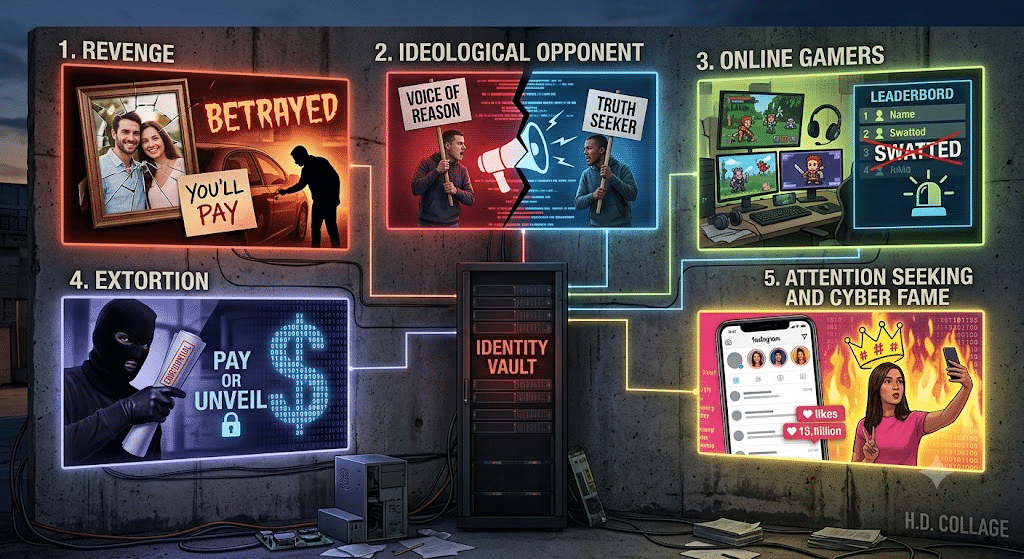
Each case can have a different motivation behind the attack. But there are common motives:
Revenge
Disagreements, breakups, and online quarrels can escalate into information attacks.
Ideological Opponent
Political views and arguments sometimes lead to the attacks on the people for revenge or to defame the opponent’s supporters.
Online Gamers
Toxic gamers who engage in harassment and expose users’ private information are not rare in online communities.
Extortion
The usage of the someone’s personal information can lead to forcing the user to make financial payments.
Attention Seeking and Cyber Fame
Unfortunately, there is no lack of doxing in the modern online world, motivated by nothing but popularity.
Red Flags That Can Alert to an Imminent Doxing Attack
In most cases, doxing is preceded by small red flags that alert to the potential attack.
They include:
- Strange attempts to log into your account
- Password reset emails
- Strange messages with personal questions
- Fake account of yours
- An increased number of spam or phishing emails
- Threats with details about you
- Messages received by your contacts about you
By following the accountable signs earlier, it helps to avoid the serious dangers of the doxing.
How Can You Prevent Yourself From Being Caught In Doxing
Taking youngsters away from the special world is impossible, but you can minimize the risk of doxing if you follow some potential habits in your regular routines.
Think before Sharing Personal Information
One of the best solutions is to reduce the quantity of personal information shared publicly. It implies refraining from sharing your:
- Address
- Phone numbers
- Daily routine
- School name
- Real-time location when traveling
Before posting randomly on the social media sites, first, ask yourself: Does this information harm my reputation and defame me? If the answer is affirmative, then you’d better keep it private.
Account Protection
Putting a random password like name, date of birth, or the dates that are easily detachable are the major security concerns. Attackers can steal it after analyzing all your crucial information, putting your privacy at risk.
Either you can:
- Set strong passwords
- Use two-factor authorization where possible
- Never reuse old passwords
- Change the password after data theft or breach.
The password generator generates a strong password for you. The main reason is to maximize your overall safety and use the password that is super crackable to decode. The choice is yours: either keep it the same or use your own; that should be strong enough so no one can enter your personal space.
Check the password setting rapidly.
Very few users tend to change their privacy settings after registration.
Try to:
- Limit your public visibility
- Restrict the tagging rights of others
- Hide personal contacts
- Control who can message you
Regular checks of privacy settings are necessary due to constant platform changes.
Do Not Open Suspicious Links
The oldest method of stealing your data was phishing. Always check whether it’s a scam:
- When asking for a login
- With email verification
- Sending prizes and offers
- Claiming urgent actions are required for payments
Check the URL carefully before clicking any link.
Delete Unnecessary Old Accounts
- Many people forget about old accounts they had several years ago.
- Try to find and delete any accounts that contain personal information.
- What action can you choose if you’re exposed to threats?
- Firstly, one should act immediately to reduce further damage.
Documentation
Take screenshots of:
- Threats sent
- Information published
- Messages received
- URLs and usernames
These are the ways you can prove your innocence, which can act as the solid proof.
Secure your personal profile instantly.
Put the strong password and enable two-factor authentication to help protect you and maintain the safety of your social platforms.
Prioritize accounts such as:
- Emails
- Banking apps
- Social media platforms
- Cloud storage services
- Instant messaging
- Reporting to the Platforms Involved
Tell the problem to the moderators of:
- Social media platforms
- Website hosting providers
- Forums
- Search engines
All of them tend to prohibit harassment or leaking private information.
Notify Your Contacts
Suppose someone tries to intrude on your personal space to disclose your confidential details. You need to talk to the people you trust. It can be a family member, a parent, a friend, or anyone close to you. The reason is that if you open up about someone threatening you, it helps prevent your mind from tricking you and provides moral support. Sharing with your loved ones keeps them alerted and others one not caught in the same situations.
Assistance from Authorities in case of serious issues
Suppose you face serious dangers, such as someone mocking, humiliating, or harassing you. You should first go to the authorities and register your complaints. The screenshots, calls, and videos are the evidence that helps you catch the attackers so they can never mislead you in the future. Always ensure your safety comes first, and it should never be compromised for any reason.
Impact Of Artificial Intelligence On The Cybersecurity Landscape
With the latest inventions, hackers are now smarter and have the new techniques to personalize attacks against you. From more advanced phishing schemes to realistic fake accounts and faster data collection, these attacks represent a whole new level of digital danger.
The increased efficiency of targeting people through personal attacks makes it necessary for users to move beyond mere awareness and towards immediate knowledge of digital dangers.
Digital Awareness – The Key To Avoiding Cyber Attack Escalation
To protect yourself from being doxxed, make sure that there is little information available about you online, and think twice before posting anything on your social media account. It should be noted that doxers usually collect various information, such as your name, email addresses, physical addresses, or passwords, over several weeks or months and use it against you.
How TheOneSpy Helps in Protecting Digital Privacy

Nowadays, people can choose different app and software to maintain their safety and privacy. When it comes to protecting one’s privacy and digital footprint from unwanted doxing attacks, TheOneSpy serves the raise awareness of certain online behaviors. Namely, using TheOneSpy enables users to monitor any suspicious actions, including:
- Abnormal online behavior
- Unsafe communication methods
- Potential exposure to harassment
- Privacy risk indicators
- Instant alert against suspicious entry
- Block stranger contact or details
- Block URLs and offending sites
Parents choose this as the best way to keep their kids’ safety regulated, see their kids’ activities live, and protect their kids without attackers reaching them.
Promote Safe Internet Usage Through Proper Awareness.
Technology is never a problem if you know how to use it sensibly. Awareness is the main guardian; people who understand the cyber threats maintain the limits on what information to disclose. That’s where the chances of encountering the attackers online become so minimal.
Using TheOneSpy as part of the comprehensive digital security practice can help users:
- Recognize and act upon risky internet activities
- Understand the importance of online privacy
- Learn about safe internet habits
- Stay protected through improved digital awareness
With these, users can get away from the cybercriminal activities and maintain a safe distance from sharing online.
Conclusion:
In today’s landscape, doxing is a more trendy phenomenon because of the latest inventions, artificial intelligence methods, and oversharing on the social media sites. Technology continues to improve, and this is the significant reason hackers come up with advanced and unique ideas to steal your data. Users can use the different software that is developed to regulate their privacy, yet awareness is always a key solution to get rid of these cybercrime activities.